Part 1 of 3 · AI-Assisted Cyber Recovery series
Introduction
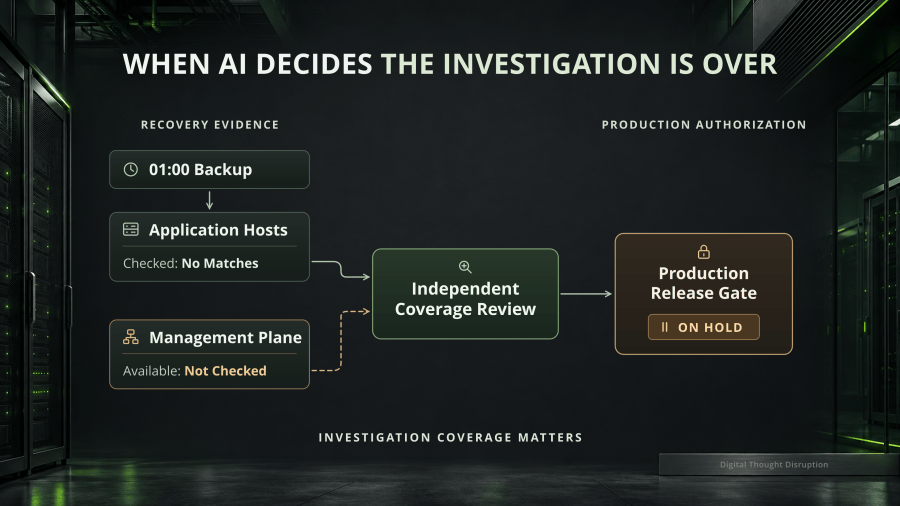
Imagine a recovery lead preparing to return a service to production after a ransomware incident. An artificial intelligence (AI) investigator found no matching indicators in the application-host logs it searched. The required management-plane audit records were available and went unexamined.
The recovery lead has to decide whether the evidence supports production release. This article proposes a way to track what investigators examined and surface any required checks that remain open.
TL;DR
AI-assisted cyber recovery introduces an important distinction between investigation findings and investigation coverage. A search that returns no matching indicators may provide useful negative evidence, but only for the assets, event types, time period, and detection method actually examined.
Enterprise recovery workflows should independently compare the investigation that occurred with the investigation required by policy. A completed check, an available but skipped evidence source, and an unavailable evidence source must remain distinguishable at the production approval gate.
Before normal production approval, verify independently that investigators performed the required checks. An AI recommendation can inform that decision.
In This Article
From Recovery-Point Selection to Investigation Coverage
On page 11 of my whitepaper, AI Agents and the Integrity of Enterprise Recovery, I introduced a recovery sequence that calls for establishing the earliest credible exposure before selecting a recovery point [1].
That raises a practical implementation question. How does the recovery lead know that the investigation supporting the selected recovery point examined the relevant evidence?
A backup timestamp establishes when a recovery copy was captured. It does not establish whether the organization was already compromised when that copy was created.
Similarly, a successful search of application-host telemetry does not establish the integrity of the management systems capable of administering those hosts.
The National Institute of Standards and Technology (NIST) Special Publication 800-61 Revision 3 provides a foundation for separating these responsibilities in the Cybersecurity Framework (CSF) 2.0 [2].
| NIST CSF 2.0 subcategory | Recovery consideration |
|---|---|
| DE.AE-04 | Estimate, understand, and refine the impact and scope of adverse events. |
| RC.RP-03 | Verify the integrity of backups and other restoration assets before use. |
| RC.RP-05 | Verify restored assets, address the incident’s root causes, and assess restoration adequacy before production use. |
These are related but distinct assurance responsibilities.
The architecture proposed in this article translates part of that guidance into an independently reviewable investigation record. It is not a NIST-prescribed AI architecture or a replacement for the broader incident response and recovery process.
Its purpose is narrower: to establish whether the required investigation was performed and whether its findings support the recovery decision being requested.
What Recent AI Investigation Research Tells Us
In October 2026, Tsegai et al. posted the preprint From Investigation Failures to Reliable SOC Agents: Understanding and Improving LLM-Based Alert Triage [3].
The researchers evaluated five approaches to AI-assisted security operations center (SOC) alert triage using ALERT-BENCH, an interactive benchmark containing 1,247 alerts and replayed enterprise telemetry.
Their investigation traces revealed an important relationship. Attack-related alerts were more frequently dismissed when the investigations retrieved no records.
An empty search result can be legitimate negative evidence. The concern raised by the study is whether an investigation has examined sufficient relevant context to justify dismissal when its searches return nothing.
That finding must remain within its experimental boundaries. ALERT-BENCH evaluated alert triage against a defined telemetry corpus. It did not measure enterprise ransomware recovery approvals or establish a production failure rate for AI-assisted recovery systems.
However, the architectural question transfers.
If an organization allows an AI-assisted investigation to inform a production release, what independently establishes that the investigation covered the required evidence?
Related research by Begimher et al., reported in the April 2026 SIR-Bench preprint, examines investigation depth in security incident response agents [4]. Its evaluation distinguishes correct triage decisions from the discovery of additional security-relevant findings through active investigation.
That distinction matters because an investigation may reach a correct classification without discovering all the evidence that would be important to a subsequent decision.
For enterprise recovery, I would extend this reasoning beyond model evaluation and into the production approval workflow itself.
Three Investigation Outcomes That Must Remain Separate
Return to the hypothetical ransomware recovery.
The application-host investigation found no matching indicators. The management-plane audit records were available but never examined.
Those are two different investigation outcomes. A third possibility exists when required telemetry cannot be obtained or is materially incomplete.
The proposed recovery policy should preserve all three states.
| Investigation outcome | What the result supports | Proposed policy response |
|---|---|---|
| Completed: no match | No matching activity was found within the verified search scope and detection method. | Accept the bounded finding as evidence for the applicable check. |
| Available but skipped | Required evidence was available, but its contents were not evaluated. No negative finding is established. | Keep the check open and withhold normal production approval until resolved. |
| Unavailable or incomplete | The required activity could not be adequately evaluated using the available evidence. | Keep the check open. Seek equivalent evidence or follow the permitted exception process. |
The second outcome is the primary concern in this article.
The organization did not lose its management-plane telemetry. Its investigators were not prevented from accessing the source. The investigation simply concluded without examining it.
That is a coverage failure.
The third outcome is an evidence availability problem. It may require a different investigation method, another authoritative source, or an explicitly accepted limitation.
Combining both into a generic status such as no evidence of compromise removes information the recovery lead needs to make a defensible decision.
A completed search that found suspicious activity must also remain distinguishable from a completed search that found nothing. Completion establishes that the check occurred. It does not establish that its result is acceptable.
Establish What the Investigation Could Actually Observe
A zero-match result needs context before it can support a consequential decision.
Imagine the AI searched three application hosts and returned an accurate report stating that no known indicators were found.
Before accepting that result, the recovery lead should be able to establish four properties.
Evidence Availability
Determine whether the required records existed, were accessible through an authorized investigation path, and were suitable for examination.
This includes verifying collection health, retention, relevant event types, source integrity, and any material gaps in the investigation period.
A reachable security information and event management (SIEM) platform does not, by itself, establish that the required telemetry was collected.
Availability should be supported by source-side records or independently maintained collection evidence, rather than inferred from the AI’s ability to connect to a search interface.
Actual Investigation Scope
Establish which assets, environments, event types, and time windows were actually examined.
The service may depend on application hosts, identity services, infrastructure management platforms, network controls, backup systems, and external integrations.
The relevant scope comes from the incident and the service’s dependency relationships.
In our example, a search of application hosts does not cover administrative activity in the management plane simply because those systems administer the hosts.
Detection Method
A completed search must also be appropriate for the security question being asked.
Searching for known malicious file hashes supports a different conclusion from reviewing administrative activity against authorized changes. Each method addresses a particular class of evidence.
The investigation record should retain the search definition or method, its applicable version, execution status, and relevant limitations.
Where appropriate, validate the detection method against representative known events to establish that the expected activity is observable through the selected evidence path.
Result Interpretation
The AI’s conclusion should remain bounded by the preceding three properties.
A defensible statement would be:
No matching indicators were identified in the specified application-host telemetry during the examined period using the recorded detection method. The required management-plane investigation remains open.
That is a useful security finding. It is also a materially different statement from declaring the service free of compromise.
The Earliest Confirmed Indicator Is Not the Start of Compromise
Suppose the earliest confirmed indicator in the hypothetical incident occurred at 04:15 Coordinated Universal Time (UTC) on the day of recovery.
The available backup was captured at 01:00 UTC.
It would be tempting to conclude that the backup predates the compromise.
What the investigation actually establishes is that malicious activity had occurred by 04:15. The beginning of the compromise remains uncertain and may be earlier than the earliest observed indicator.
The distinction becomes especially important when the required management-plane investigation remains incomplete.
A recovery-point assessment should therefore consider the earliest credible exposure, the evidence supporting that estimate, the observation period, and any uncertainty that could affect the selected copy.
The 01:00 backup remains a candidate recovery point. Its readability is useful evidence, but it is not a security clearance.
If subsequent investigation changes the estimated exposure period, the recovery-point decision may need to be revisited.
Design an Independent Investigation Coverage Review
The AI should be able to search evidence, correlate findings, explain inconsistencies, propose additional investigations, and recommend recovery actions.
It should not be the sole authority determining whether the investigation requirements have been satisfied.
I would separate the architecture into four responsibilities.
| Architectural responsibility | Authoritative record |
|---|---|
| Required investigation | Versioned recovery policy and incident-specific requirements |
| Evidence availability | Source inventory, collection records, and evidence integrity information |
| Investigation performed | Independently verifiable query and investigation records |
| Recovery authorization | Release workflow and accountable decision owner |
The recovery policy determines which checks are required. Evidence sources establish what was available. Query records establish what was examined.
The AI’s findings remain an important input, but the release workflow independently evaluates the required coverage.
Required checks + source records
                |
                v
Compare with recorded execution
                |
                v
Coverage and findings accepted?
  |-- Yes -> Check other gates
  `-- No  -> Hold normal release

New material evidence -> Reassess
Figure 1. Independent investigation coverage review before production approval.
The important boundary is between investigation and authorization.
The AI can finish its assigned task. The recovery workflow does not have to interpret that completion as satisfaction of the recovery policy.
Even when investigation coverage is satisfied, the service must still meet its other production release requirements, including applicable restoration integrity, containment, remediation, dependency validation, and business acceptance criteria.
What a Recovery Approval Record Should Show
The recovery lead should not have to reconstruct investigation coverage by reading hundreds of tool calls or searching through an AI conversation transcript.
The underlying execution records should be retained, but the approval screen needs a concise representation of the decision-critical evidence.
Consider the following illustrative approval record for our hypothetical incident. The identifiers, assets, and investigation window are synthetic. No actual investigation or recovery exercise was performed.
Service: Customer portal
Candidate recovery point: Day 0, 01:00 UTC
Requested action: Return the customer portal to production
Decision owner: Recovery lead, operating under the incident recovery policy
| Record field | Application-host investigation | Management-plane investigation |
|---|---|---|
| Required check and owner | Host indicator review; SOC lead | Administrative activity review; platform security lead |
| Expected scope | Three application hosts; process and file telemetry; Day -2, 00:00 to Day 0, 08:00 UTC | Management systems administering those hosts; administrative authentication, privilege and configuration changes; same period |
| Actual coverage | All three hosts and specified event types examined for the required window | None |
| Source reference or gap | Evidence set E-101; verified query record Q-101 | Evidence set E-102 available; no execution record for the required check |
| Result | Completed; zero matching indicators using the recorded method | Open; available but skipped |
| Decision that depends on it | Host investigation acceptance | Recovery-point acceptance and production reconnection |
| Reassessment condition | New relevant indicators, evidence-quality concerns, or expanded host scope | Complete the required investigation or obtain approved equivalent evidence |
Production decision: On hold.
The application-host investigation supports its specific negative finding. The management-plane requirement remains unresolved.
This example is deliberately small. A production implementation may contain dozens of required checks, but the recovery lead needs to understand which unresolved items affect the requested action.
The record should make that dependency visible without requiring the decision-maker to interpret the agent’s internal reasoning.
The practical improvement is that the omitted investigation becomes a visible work item with an owner, an evidence source, and a dependent decision.
It can no longer disappear into a summary that simply reports no matching indicators.
Make Required Checks Observable in the Workflow
A practical implementation does not necessarily require a new security platform.
Existing incident management, security orchestration, automation and response (SOAR), SIEM, evidence repositories, and IT service management (ITSM) systems may provide parts of the required architecture.
The integration work is establishing trustworthy relationships between them.
Define the Required Investigation
Create a versioned set of investigation requirements derived from recovery policy, service dependencies, and the known or suspected incident scope.
The incident lead should approve material scope changes. An AI agent may recommend adding or modifying a check, but it should not silently remove an existing requirement.
Each required check needs a stable identifier so that its execution evidence can be associated with the correct obligation.
Capture Execution Evidence Independently
When an investigator or AI agent performs a required search, retain the execution record outside the generated narrative.
Depending on the investigation platform, this may include the source-side query identifier, authenticated requester, submitted search definition, resolved asset scope, time interval, execution outcome, and a protected reference to the results.
Distinguish successful empty results from failed searches, truncated responses, incomplete execution, and searches that never occurred.
A tool-call count is not sufficient. It establishes activity, not necessarily investigation coverage.
Where the source cannot provide trustworthy execution records, use an approved capture mechanism or an accountable analyst’s documented examination of the primary evidence. Preserve the limitation rather than manufacturing machine-verifiable evidence.
Evaluate Coverage Before Approval
The release workflow compares the required investigation with the independently recorded work.
A normal production approval should remain blocked when a required check is open, materially incomplete, or has an unresolved adverse finding.
Deterministic workflow logic can evaluate structured conditions such as the presence of required records, coverage of defined assets and periods, and approved dispositions.
Assessing whether an investigation method was technically adequate may still require a qualified security reviewer.
The objective is not to automate every aspect of forensic judgment. It is to prevent required work from disappearing between the investigation and the approval decision.
An Open Check Does Not Have to Stop All Recovery Work
Incident recovery involves competing responsibilities.
The organization may need to investigate uncertain exposure while preparing infrastructure, validating backup material, and restoring critical capabilities into an appropriately isolated environment.
An unresolved production release requirement should prevent the action that depends on it. It does not automatically require unrelated or independently authorized recovery activities to stop.
Under the proposed architecture, the incident lead has three controlled paths available.
| Recovery path | Required condition | Permitted outcome |
|---|---|---|
| Further investigation or equivalent evidence | The check is completed, or the security owner confirms an alternative adequately addresses the original requirement. | Reevaluate the normal release decision. |
| Continued isolated validation | The activity is independently authorized and satisfies its own safety and restoration prerequisites. | Continue the specified validation without reconnecting the production service. |
| Documented exception | The governing runbook permits an exception and the designated authority accepts the residual risk. | Perform only the explicitly authorized action within the exception’s scope. |
An exception is not evidence that the omitted check passed.
For example, the recovery lead might authorize additional isolated application validation while the platform security lead examines the management-plane records.
The record should identify the uncertainty, the accepted risk of the limited activity, its owner, its permitted connectivity and operating boundaries, and the conditions under which that authorization expires or must be reconsidered.
A normal production release remains on hold.
Where a runbook permits an exceptional production action, the approval must identify that action precisely, together with its compensating controls, risk owner, duration, and reassessment conditions. Mandatory requirements that the runbook does not allow the organization to waive remain binding.
This preserves operational flexibility without turning business urgency into an undocumented security override.
Make Recovery Decisions Correctable
Investigation coverage is not necessarily static.
New evidence may arrive after a decision has been made. A previously unavailable record may become accessible. A newly identified dependency may expand the investigation boundary.
Suppose that, after the required management-plane review is eventually completed, additional evidence indicates that suspicious administrative activity occurred earlier than previously understood.
That finding could affect the recovery point selected, the systems included in the investigation, or the conditions under which the service was authorized to operate.
The recovery architecture should retain the relationship between the evidence and the decision that relied on it.
When a material finding changes an earlier assumption, notify the accountable decision owner and mark the affected approval for reassessment. Prevent further dependent release actions until the applicable review is completed.
Where the service has already returned to production, the incident lead should evaluate the new evidence against the documented containment and rollback conditions.
Preserve the original approval record and the subsequent reassessment. Do not rewrite history to make the original decision appear to have been made with evidence that arrived later.
This is an important Day-2 requirement for AI-assisted incident response. An organization needs the ability to correct a consequential decision, not merely update the investigation summary.
What Enterprise Architects Should Require in a Design Review
Before integrating AI-assisted investigation into a production recovery workflow, architects should be able to demonstrate the following capabilities:
| Design review area | Required demonstration |
|---|---|
| Policy ownership | Recovery policy defines mandatory investigation requirements independently of the AI. |
| Evidence availability | Required sources have identifiable owners, availability records, and evidence-quality limitations. |
| Execution evidence | Investigations produce verifiable records of the assets, event types, time periods, and methods examined. |
| Result classification | Completed negative findings remain distinguishable from skipped checks and missing evidence. |
| Production authorization | Normal production approval cannot advance solely because an AI agent declares its investigation complete. |
| Exception governance | Exceptions are independently authorized, explicitly scoped, and retained as risk decisions. |
| Decision reassessment | Material new evidence can return an affected approval to its accountable owner for reassessment. |
These are proposed design acceptance criteria, not measured results from an implemented recovery system.
A useful next step is to evaluate them through a controlled tabletop exercise using synthetic evidence and a simulated production release workflow.
The exercise should establish whether a technically accurate AI-generated investigation summary can cause a required but omitted security check to disappear from the approval decision.
That is a different test from measuring whether the AI can identify ransomware indicators.
Continuing the Series
This article establishes the investigation coverage problem and the architectural boundary between AI-assisted analysis and production authorization.
The next two articles will develop the implementation and validation of that boundary.
The November 29 installment, What a Recovery Approval Should Prove, will examine the evidence contract, decision records, and independent release controls needed to implement the architecture.
The November 30 installment, Testing an AI-Assisted Recovery Decision, will define a proposed controlled exercise for evaluating skipped checks, incomplete telemetry, late findings, and production approval behavior.
The series will contribute to the proposed technical whitepaper, Verifying Investigation Coverage in AI-Assisted Cyber Recovery.
Any measured results will be reserved for the completed exercise.
Conclusion
AI can make a security investigation faster, more accessible, and easier to interpret. Those advantages become more useful when the organization can independently establish the boundaries of the work performed.
In the hypothetical ransomware recovery, the AI’s application-host finding was accurate. The unresolved problem was that the investigation did not include a required source of evidence, and the production approval depended on that source.
Enterprise architects should make investigation coverage an explicit property of the recovery workflow. The recovery policy should determine what must be investigated, independently verifiable records should establish what was examined, and the release workflow should enforce the conditions for normal production approval.
The next time you review an AI-assisted cyber recovery architecture, ask the team to demonstrate something specific:
Show me a completed check that found nothing, then show me a required check nobody ran. How would the production approval screen distinguish them?
Related Posts
Cyber Recovery After Management-Plane Compromise. Identify the systems and evidence that shape a recovery decision after a management-plane incident.
The Re-Entry Test. Verify eradication and assess whether an isolated service can safely reconnect.
External References
[1] P. Bryant, AI Agents and the Integrity of Enterprise Recovery, Digital Thought Disruption, technical white paper, p. 11, Nov. 2026.
[2] A. Nelson, S. Rekhi, M. Souppaya, and K. Scarfone, NIST SP 800-61 Rev. 3: Incident Response Recommendations and Considerations for Cybersecurity Risk Management, Cybersecurity Framework 2.0 Community Profile, pp. 26, 34, Apr. 2025.
[3] S. A. Tsegai, A. Kantchelian, D. Yao, and P. Gao, From Investigation Failures to Reliable SOC Agents: Understanding and Improving LLM-Based Alert Triage, arXiv preprint 2610.10608, Oct. 2026.
[4] D. Begimher, C. Leo, J. Huang, P. Gaw, and B. Zheng, SIR-Bench: Evaluating Investigation Depth in Security Incident Response Agents, arXiv preprint 2604.12040, Apr. 2026.