Introduction
Imagine a property management company introducing an AI assistant to help its maintenance dispatchers.
This is a fictional example used to examine how an AI-assisted workflow can become a business dependency.
The assistant reads incoming maintenance requests, summarizes the reported problem, and recommends which queue should handle the work. A dispatcher reviews the recommendation and decides whether to assign a technician, request more information, or escalate the issue.
The initial arrangement is deliberately conservative. The AI assistant does not independently authorize repairs, dispatch contractors, or close work orders. Human dispatchers retain responsibility for operational decisions.
The pilot produces enough value that managers begin adjusting how the team works. Routine classification takes less time. Dispatchers process more requests. Supervisors gradually reduce the number of staff assigned to manual intake and move experienced employees to other responsibilities.
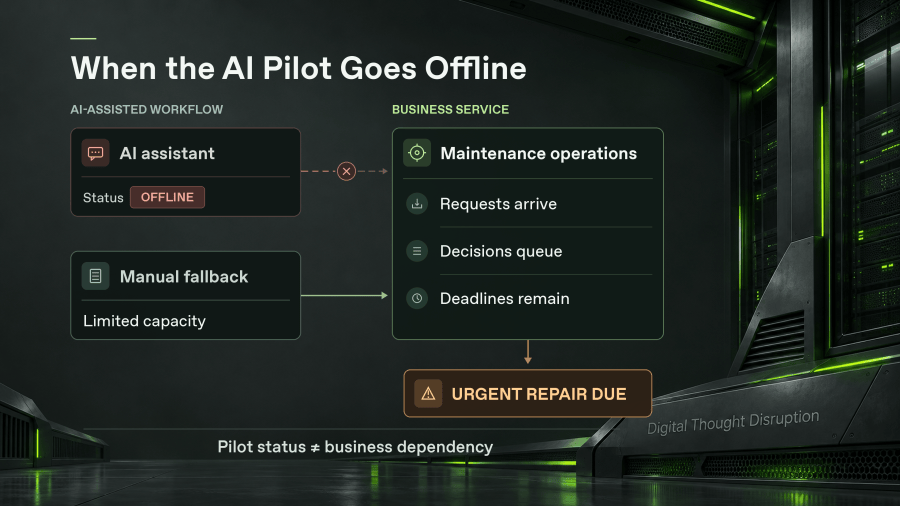
Six months later, the assistant becomes unavailable during a normal operating shift.
Residents can still submit maintenance requests. The work order application is available. The underlying database is healthy. No technician scheduling system has failed.
But the remaining dispatchers can no longer process requests at the rate they arrive. Work begins accumulating, and an urgent repair requiring a decision before noon is still sitting in the intake queue.
The problem is not necessarily that the AI platform failed unusually. The problem is that the organization changed how it delivers its maintenance service without revisiting the consequences of losing the assistant.
A tool approved for experimentation has become part of the business’s effective production operating model.
The question is no longer whether the pilot works. It is whether the business can still meet its commitments when the pilot does not.
TL;DR
An enterprise AI pilot can become operationally critical without ever receiving formal production approval. The change often happens outside the AI platform. Staffing is reduced, work is redistributed, manual procedures fall out of use, and service commitments begin depending on the automation being available.
When the AI assistant becomes unavailable, the underlying applications may continue operating while the business loses the capacity to process the work arriving through them. A technically healthy service can still miss customer commitments because the decision-making workflow cannot keep up.
The practical requirement is to govern AI dependency as an operating-model decision, measure the capacity of the fallback, and prove that essential business outcomes remain achievable when the AI component is unavailable.
In This Article
The AI Dependency Changed Without a Production Launch
Traditional production governance often attaches significance to identifiable technical events.
An application is deployed into production. A new integration is enabled. A service account receives additional permissions. A workload is migrated onto an approved platform. A system is added to the service catalog.
These are useful control points because they create opportunities to reassess security, capacity, support, availability, and recovery requirements.
AI introduces another route through which operational dependency can grow.
The technology may remain exactly where it started while the surrounding organization changes.
A pilot that initially assists three dispatchers might eventually influence workforce scheduling, escalation procedures, customer response expectations, and decisions about how many people are required during a shift.
Nothing about that transition necessarily requires a model upgrade, a new API integration, or a change to the assistant’s permissions.
Yet the consequences of an outage have changed substantially.
Technical Criticality and Business Criticality Are Different
Consider two assessments of the same AI assistant.
| Assessment | During the original pilot | After operational adoption |
|---|---|---|
| Technical environment | Limited AI-assisted workflow | Same workflow and integrations |
| Human oversight | Every recommendation reviewed | Every recommendation still reviewed |
| Staffing | Enough staff to process work manually | Staffing assumes AI-assisted throughput |
| Manual procedures | Regularly exercised | Infrequently used |
| Service commitments | Independent of AI availability | Increasingly dependent on AI throughput |
| Outage consequences | Reduced productivity | Backlog, delayed dispatch, possible missed deadlines |
| Governance classification | Pilot | Still called a pilot |
The software has not necessarily become more dangerous. The business has become more dependent on it.
This distinction matters because normal technology reviews can miss changes that originate in workforce planning, process redesign, service management, or operational budgeting.
NIST’s Artificial Intelligence Risk Management Framework: Generative Artificial Intelligence Profile provides a useful governance reference. Its post-deployment recommendations address monitoring, human override, decommissioning, incident response, recovery, and change management. [1]
NIST’s March 2026 publication, Challenges to the Monitoring of Deployed AI Systems, also identifies the importance of monitoring unexpected consequences when AI systems operate in changing deployment contexts. [2]
These sources do not establish a specific staffing rule for property management companies. They reinforce a broader architectural principle: AI risk must be reviewed against the context in which the system actually operates, not only the conditions under which it was originally approved.
That leads to an important governance decision.
When the operating model changes materially, the AI dependency assessment should reopen, even when the AI technology itself has not changed.
Map the Business Service Before the AI Component
A useful dependency assessment begins with the work the organization has committed to perform.
In the property management example, residents expect maintenance requests to be received, evaluated, and acted on within an appropriate period. The business must distinguish routine work from urgent conditions, assign responsibility, and preserve enough information for dispatchers and technicians to complete the next step.
The AI assistant supports one part of that service. It does not own the entire outcome.
That distinction should be visible in the architecture.
The following conceptual design illustrates a proposed continuity arrangement. The authoritative maintenance record remains available to both normal and degraded operations. A separate urgent-work screening process prevents the organization from relying exclusively on AI-generated classifications to identify time-sensitive requests.
Resident maintenance requests
             |
             v
Work order record + urgent screen
             |
     +-------+---------+
     v                 v
AI routing advice    Manual triage
     |                 |
     +-------+---------+
             v
Human dispatcher assigns work
             |
             v
Record and verify the outcome
Illustrative dispatch workflow: authoritative requests and priority screening remain available in degraded mode, with human decision authority and recorded service outcomes.
The important architectural boundary is the connection between the authoritative intake record and the dispatch decision.
If the assistant becomes unavailable, dispatchers must still be able to find requests, inspect the original information, identify urgent conditions, record decisions, and assign work.
A fallback that depends on an AI-generated summary or queue assignment that is no longer being produced may fail even when the work order system remains available.
The architecture therefore needs to answer several questions.
- Can staff retrieve every accepted request without going through the assistant?
- Can urgent conditions be identified without relying solely on an unavailable AI classification?
- Can dispatchers act using their existing permissions and approved procedures?
- Will decisions made during degraded operation be preserved in the authoritative work order system?
- Can the organization reconcile work completed manually when normal AI-assisted processing resumes?
These questions establish a more useful continuity boundary than model availability alone.
The goal is not to duplicate every AI capability. It is to preserve the minimum set of business functions required to maintain an acceptable service.
Reopen the Review When the Operating Model Changes
A pilot should not need to undergo a full architectural assessment every time a manager changes a shift schedule.
However, some operational changes affect the assumptions under which the pilot was approved.
I would establish an event-driven review process tied to material changes in business dependency.
| Change trigger | Why it matters | Required decision |
|---|---|---|
| Manual staffing is reduced | Available fallback throughput may decline | Is sufficient capacity retained for essential work? |
| Previous intake procedures are retired | An independent processing path may disappear | Can requests still reach a dispatcher? |
| Time-sensitive work is added | Delays may have greater consequences | What deadlines must the fallback protect? |
| AI use expands to additional teams | Outage exposure and competing demand increase | Does shared fallback capacity remain adequate? |
| Service commitments become more demanding | Existing recovery assumptions may no longer apply | Can degraded operation meet the revised commitments? |
| Staff stop practicing manual procedures | Capability may deteriorate despite documented instructions | Can the current roster execute the fallback? |
These triggers are recommendations for governance design, not regulatory requirements.
They are useful because they connect AI oversight to changes that can otherwise happen without involving the AI platform team.
Separate Pilot Approval from Business Dependency Approval
The original AI project may have been approved to evaluate whether summarization reduces dispatcher effort.
That approval does not automatically authorize management to reduce manual staffing, eliminate an alternate intake procedure, or rely on the assistant to sustain a critical service commitment.
Those are different decisions with different owners.
The technical team can establish whether the assistant is operating within its approved architecture. The business service owner must decide whether the resulting operating model has an acceptable continuity posture.
This creates a practical approval boundary:
Material changes in service dependency require business continuity review, even when no production software change is proposed.
An organization does not necessarily need to end the pilot immediately. It does need to recognize that the pilot is supporting operational commitments and govern that dependency accordingly.
Manual Fallback Is a Capacity Problem
A common continuity assumption in AI-assisted workflows is that people can simply resume the work if the assistant becomes unavailable.
That may be true at small volumes.
It may stop being true after staffing levels, workload volumes, and service expectations change.
Consider a deliberately simplified maintenance operation.
The following numbers are fictional assumptions, not observed performance measurements.
| Metric | Illustrative rate |
|---|---|
| Incoming requests | 60 requests per hour |
| Manual processing capacity | 25 requests per hour |
| Backlog growth | 35 requests per hour |
| Time into outage | Requests received | Manually processed | Outstanding work |
|---|---|---|---|
| 0 hours | 0 | 0 | 0 |
| 1 hour | 60 | 25 | 35 |
| 2 hours | 120 | 50 | 70 |
This fictional example assumes constant arrival and processing rates, comparable units of work, and zero initial backlog. The table shows accumulated requests rather than measured operating results.
In this example, arrivals exceed manual processing capacity throughout the outage.
Backlog growth = arrival rate – processing rate
60 – 25 = 35 additional requests per hour
If the outage lasts two hours, and the arrival and processing rates remain constant, the manual team accumulates 70 additional outstanding requests.
For a real queue, start with existing work and measure net arrivals and completions by priority. While there is work waiting, capacity above the arrival rate can reduce the backlog.
Real maintenance workloads rarely behave that neatly. Some cases require several minutes. Others require immediate escalation, specialist judgment, or coordination with an external contractor.
The calculation is still useful because it establishes a basic constraint.
The business cannot maintain normal throughput indefinitely with a fallback that processes fewer requests than it receives.
Backlog Size Does Not Tell You Which Commitments Failed
A queue containing 70 additional requests is not necessarily a continuity failure if most of those requests can safely wait.
The important question is what the queued work represents.
An ordinary maintenance request to repaint a damaged wall can often be deferred.
A report of significant water entering an occupied unit may require urgent assessment to prevent further damage or unsafe conditions.
The fallback therefore needs prioritization as well as capacity.
An organization might accept a large routine backlog while protecting a smaller set of time-critical requests. That can be a defensible degraded operating model when the criteria, escalation rules, and capacity have been established in advance.
What it cannot do is assume that normal service commitments remain achievable simply because employees are still processing requests.
Recovery Can Create a Second Capacity Problem
Suppose the assistant becomes available again after a two-hour outage, and the combined restored workflow can now process 80 requests per hour while 60 new requests continue arriving.
The net capacity available to reduce the backlog is 20 requests per hour.
Under the same simplified assumptions:
Backlog clearance time = 70 / (80 – 60) = 3.5 hours
The technology outage lasted two hours. The additional work could take another three and a half hours to clear.
This is not a prediction for an actual maintenance organization. It demonstrates why recovery time and service recovery are different measures.
Restoring AI availability does not instantly eliminate the operational consequences of its absence.
Design a Degraded Service, Not Just an Emergency Procedure
A manual procedure is useful only when it describes an operating arrangement the organization can execute with the people, permissions, tools, and information actually available.
The alternative to AI-assisted processing should therefore be designed as a defined degraded service.
That service should make explicit which outcomes remain protected, which work may wait, and which decisions require escalation.
Preserve the Essential Work
For the maintenance company, a realistic degraded mode might prioritize emergency maintenance, urgent safety-related requests, and existing commitments approaching their deadlines.
Routine classification and lower-priority administrative work could be delayed until capacity becomes available.
This is more defensible than promising that every request will continue receiving its normal service level.
It also allows managers to make decisions using evidence rather than attempting to preserve an impossible throughput target.
Protect the Human Decision Path
An AI assistant that provides recommendations should not become the only practical way for dispatchers to find or understand the underlying requests.
The degraded workflow should preserve access to original submissions, priority information, previous communications, work order history, and approved escalation channels.
Where priority identification depends on AI-generated classifications, the organization needs an alternative method for detecting urgent cases. That might be a deterministic rule, a dedicated urgent reporting channel, or direct human screening, depending on the service.
Each option has limitations.
A rule may miss unusual circumstances. A separate reporting channel may not be available to every customer. Human screening is constrained by staffing and expertise.
Those limitations belong in the continuity assessment, not in an incident report after the fallback has already failed.
Decide What Reduced Service Means for Customers
The business may need to communicate that routine maintenance responses will be delayed while urgent work continues.
That communication should reflect actual operational capability. Telling customers that the application is available does not adequately explain that dispatch decisions are taking longer.
Degraded service also requires a time boundary.
A fallback that works for 30 minutes may be unsustainable for an entire day, especially if employees must cover breaks, other responsibilities, and a growing backlog.
The UK Financial Conduct Authority’s November 2026 operational resilience review provides a relevant warning from financial services. It identifies firms relying on manual workarounds without demonstrating that those arrangements can scale across large numbers of affected users or services during severe or extended disruption. [3]
The FCA observations concern regulated financial services firms and do not impose those regulations on the fictional property management company.
The engineering lesson is transferable: a documented workaround is not evidence that the workaround has sufficient capacity.
Prove the Business Can Operate Without the Assistant
Once the fallback has been designed, it needs an exercise that resembles the conditions under which it would actually be used.
A short demonstration in which one dispatcher processes five prepared cases is unlikely to establish meaningful continuity capability.
It can show that the manual procedure is understandable. It cannot establish that the available team can sustain the required service.
A more useful exercise runs for a representative operating period and keeps the workload realistic.
Establish the Exercise Boundary
Use synthetic or appropriately de-identified maintenance requests in a controlled exercise. Do not disrupt production request processing or conceal urgent resident needs to create a realistic test.
Define the scenario before beginning:
- Workload: A representative mix of routine, urgent, incomplete, and duplicate requests.
- Staffing: The roster that would actually be available during the intended failure period.
- Failure condition: The AI assistant provides no usable summaries or routing recommendations.
- Available systems: Only the systems and communication channels expected to remain available in that scenario.
- Service requirements: Business-approved deadlines for essential work, with an explicit allowance for deferred routine activity.
- Duration: Long enough to observe accumulating work and a shift handoff, if that is part of the continuity requirement.
The exercise should distinguish an AI-only outage from a broader event affecting identity, communications, or the work order system. Those scenarios may require different fallback designs and should not be treated as interchangeable.
Measure Work Completed, Not Activity Reported
A dispatcher opening a request is not the same as evaluating it.
A priority label is not necessarily a completed decision.
A work order marked assigned does not prove that the required maintenance service was delivered.
The exercise should distinguish these stages while measuring the outcomes that matter to the service owner.
| Measure | What it establishes |
|---|---|
| Time to first urgent decision | Whether urgent work receives timely attention |
| Oldest outstanding urgent request | Whether critical cases are becoming stranded |
| Verified decisions per hour | Actual fallback processing throughput |
| Outstanding work by priority | Size and consequence of accumulating demand |
| Missed service deadlines | Commitments that could not be met |
| Carryover to next shift | Whether degraded operation remains sustainable |
| Incorrect or duplicate decisions | Quality and reconciliation risks introduced by fallback |
Pass criteria should be established against actual business requirements before the exercise.
A company whose urgent maintenance commitments require a decision within a defined period should test that period directly.
An organization should not invent a universal recovery time objective for every AI workflow or assume that meeting an infrastructure availability target proves the service is resilient.
Test an Extended Failure, Not Only a Clean Outage
A useful second scenario keeps the assistant unavailable long enough for the fallback backlog to affect the next shift.
Does the next dispatcher inherit enough context to identify which requests are still awaiting decisions?
Can the team separate requests that were reviewed from those merely acknowledged?
Does the backlog obscure newly arriving urgent work?
Can supervisors increase capacity without losing control over work order ownership?
These questions reveal operational vulnerabilities that a brief failover demonstration will not.
Returning Online Requires Its Own Recovery Procedure
The exercise should not end when the AI assistant becomes available again.
During degraded operation, staff may have changed priorities, added notes, reassigned requests, contacted contractors, or completed work without the AI component participating.
The assistant may also have retained earlier summaries or workflow state, depending on the implementation.
If the organization resumes normal processing without reconciliation, it can create duplicate assignments, outdated recommendations, or confusion over which work has already been completed.
The recovery procedure should therefore establish a known-good operational state.
That includes confirming the assistant is functioning, validating access to current authoritative records, ensuring any retained context is appropriate, and checking whether work completed during fallback is visible to normal processing.
Before unrestricted resumption, the dispatcher or designated service owner should verify that urgent outstanding cases remain correctly prioritized.
A gradual return can be safer than immediately processing the entire accumulated queue with AI assistance.
The organization may choose to resume new requests first, reconcile manually processed cases, and then work through the remaining backlog.
The correct sequence depends on the application’s architecture and the business service.
What matters is that the sequence has an owner and a validation point.
AI recovery is complete when the supported business workflow has returned to an accepted operating state, not merely when the model endpoint responds again.
Make the Dependency Visible to Business and Technology Owners
The final governance step is to record what the organization now relies on.
This does not require an elaborate new governance framework. It requires a service dependency record that connects the technical component to the business operation it supports.
A practical record for this scenario would contain:
| Dependency field | Information to document |
|---|---|
| Business service | Maintenance intake, triage, and dispatch |
| Business owner | Role accountable for maintenance service outcomes |
| AI-supported function | Request summarization and queue recommendations |
| Authoritative system | Work order application |
| Operating dependency | Staffing and throughput assumptions dependent on AI |
| Essential commitments | Defined urgent-work decision and escalation requirements |
| Normal capacity | Measured AI-assisted human processing throughput |
| Fallback capacity | Measured manual throughput under representative conditions |
| Degraded mode | Priority rules, available channels, and permitted service reductions |
| Activation authority | Role authorized to move the service into fallback |
| Recovery authority | Role authorized to resume AI-assisted operations |
| Evidence | Exercise results, exceptions, backlog measures, and unresolved risks |
| Review triggers | Staffing, demand, workload, process, or service commitment changes |
The values should come from the organization’s own operating evidence. They should not be populated with estimates presented as tested results.
Separate the Decision Owners
The business service owner should accept or reject the proposed degraded service against customer obligations and operational risk.
The AI platform owner should establish the conditions under which the technical capability is available, restricted, restored, or disabled.
The operations lead should maintain the staffing, training, prioritization, and execution procedures needed to continue the service.
Security and risk teams should participate where the AI failure involves unsafe behavior, unauthorized access, compromised data, or other risks that make immediate restoration inappropriate.
These responsibilities may sit with different people. The objective is to prevent the business from assuming that the team operating the model also owns the service outcomes.
Give Leadership a Real Decision
After the dependency assessment and fallback exercise, leadership may have several defensible choices.
The organization could retain sufficient trained dispatch capacity to protect urgent work. It could invest in an alternate processing path. It could introduce additional capacity during defined incidents. It could reduce nonessential service commitments during disruption with appropriate notification.
A redundant AI provider might help with a narrow model-service outage, but only if the alternative is sufficiently independent and can meet the required quality, security, data, integration, and capacity conditions. It will not resolve an outage caused by a shared work order system or an operating process that depends on unavailable information.
Each option introduces cost and operational tradeoffs.
The decision should be based on the minimum service the business needs to deliver, the demonstrated capacity of the fallback, and the consequences of missing commitments.
If the organization chooses to accept a gap, that acceptance should be explicit, owned, and subject to review.
Conclusion
An AI pilot becomes operationally important when the organization begins making decisions that assume its continued availability.
The transition may have little to do with the model or application architecture. It can happen when managers reduce manual staffing, remove alternate workflows, tighten service commitments, or allow essential decisions to depend on AI-assisted throughput.
That is why production readiness cannot be determined solely by a deployment status, an approval record, or a service availability dashboard.
The business needs to understand what work continues arriving when the assistant stops, how quickly people can process it, which commitments must still be honored, and how normal operations can resume without losing or duplicating work.
The practical next step is to select one AI-assisted workflow whose usage has grown beyond its original pilot assumptions. Reconstruct its current operating dependencies, calculate available fallback capacity, and conduct a representative degraded-operation exercise.
Then ask the business owner a direct question:
If we turn this AI assistant off for the rest of the shift, which commitments can we still meet, and what evidence proves it?
The answer tells you whether the organization still has an experiment or already has a critical dependency that needs to be managed.
External References
[1] NIST, Artificial Intelligence Risk Management Framework: Generative Artificial Intelligence Profile. AI 600-1, July 2024. See MANAGE 4.1.
[2] NIST, Challenges to the Monitoring of Deployed AI Systems. AI 800-4, March 2026.
[3] Financial Conduct Authority, Operational resilience: demonstrating resilience in practice. November 11, 2026.