TL;DR
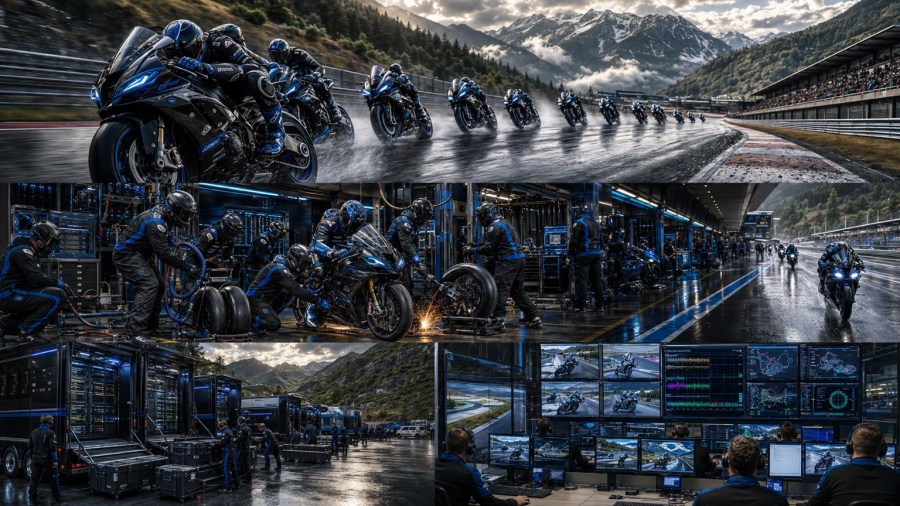
A high-performing private cloud is not defined by how quickly an administrator can click through a change. It is defined by how consistently the organization can observe conditions, make a bounded decision, execute a standardized action, validate the result, and learn from the outcome. The race-team metaphor in the image provides a useful operating model for VMware Cloud Foundation: workloads are on the track, VCF Operations is the pit wall, VCF Automation is the service entry point, lifecycle management is the pit crew, and platform engineering turns every successful intervention into a repeatable pattern.
Introduction
Private-cloud operations need a repeatable path from observed conditions to an authorized change and a verified service result. Standardize the preparation, decision rights, execution, and recovery work so operators can respond promptly without improvising the controls.
Private cloud operations should work the same way.
Many organizations still operate virtual infrastructure as a collection of consoles, product specialists, maintenance calendars, and ticket queues. The technology may be integrated, but the operating model remains fragmented. One team sees capacity pressure, another owns the network, another manages certificates, and a fourth controls the change window. By the time the organization reaches a decision, the original condition may have changed.
VMware Cloud Foundation can provide a more unified platform, but software alone does not create operational speed. The real advantage appears when fleet management, infrastructure operations, lifecycle management, automation, diagnostics, and team ownership are assembled into one closed-loop system.
The goal is not reckless velocity. The goal is controlled pace: faster delivery, faster diagnosis, safer change, and clearer accountability.
What the Image Gets Right About Private Cloud Operations
The image combines four environments that are often separated in enterprise IT: the race track, the pit lane, the platform garage, and the operations control room. Each represents a different responsibility in a mature private cloud.
The track is where business services run. Applications, virtual machines, Kubernetes clusters, data platforms, and AI workloads are exposed to demand, latency, dependency failure, security threats, and changing consumption patterns.
The pit lane is the controlled path for intervention. It is where a workload, host, cluster, or platform service moves from normal operation into a governed maintenance or remediation workflow.
The garage contains the repeatable engineering system. This is where teams maintain validated versions, automation modules, configuration baselines, recovery procedures, certificates, images, and test evidence.
The control room turns telemetry into decisions. It correlates health, performance, capacity, logs, topology, and known diagnostic findings so the team can determine what is happening, what matters, and who owns the next action.
None of these zones is sufficient by itself. A dashboard without an execution path creates awareness without improvement. Automation without telemetry creates fast mistakes. A skilled operations team without standardization becomes a human bottleneck. A service catalog without lifecycle discipline slowly fills with outdated and unsupported patterns.
The operating model succeeds when all four zones work as one system.
Scope and Assumptions
This mental model assumes a VMware Cloud Foundation 9.x environment with centralized platform operations and a team responsible for shared private-cloud services. It applies whether the organization is building a new VCF fleet or progressively bringing existing vSphere, vSAN, NSX, automation, and operations environments under a more consistent operating model.
The article does not assume that every action should be autonomous. It assumes the opposite: execution authority should increase only when the action is well understood, observable, reversible, and supported by evidence.
It also separates platform health from workload health. VCF Operations can provide platform and infrastructure visibility, but application owners still need service-level indicators, dependency knowledge, and acceptance criteria that reflect business outcomes.
The Closed-Loop Operating Model
The central lesson is that high performance comes from a loop, not a console.
The diagram below shows the minimum operational cycle. Notice that validation and learning are part of the flow. A change is not complete when a task reports success. It is complete when the platform and the affected service return to an acceptable state, and the evidence is captured for the next event.
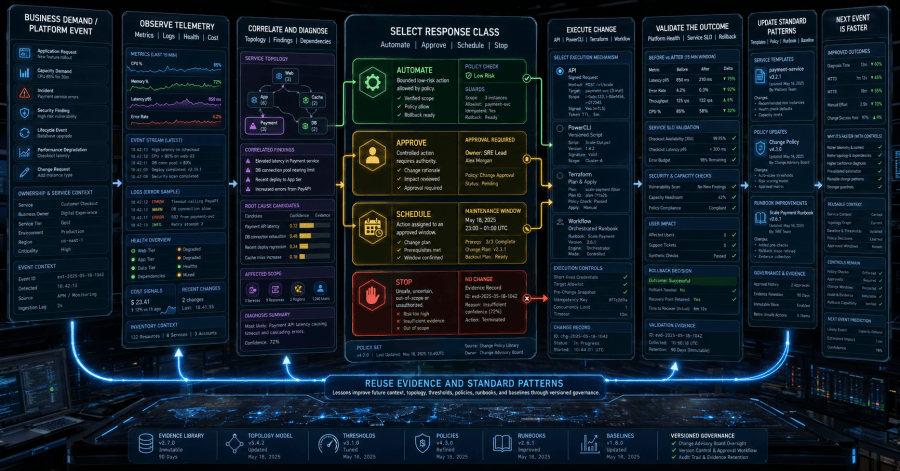
This loop changes how a platform team thinks about operations. Monitoring is no longer a separate activity. Automation is no longer a library of disconnected scripts. Lifecycle management is no longer a quarterly project. Each capability becomes part of an operational feedback system.
Mapping the Race Team to VMware Cloud Foundation
The metaphor becomes useful when it maps to real platform capabilities and ownership.
| Race-team element | Private-cloud meaning | VCF-aligned capability | Operational question |
|---|---|---|---|
| Motorcycle on track | Running workload or business service | vSphere, vSAN, NSX, VKS, workload domains | Is the service meeting its objective? |
| Track conditions | Demand, risk, latency, dependency state | Infrastructure and workload telemetry | What changed in the environment? |
| Pit wall | Central operational awareness and decision support | VCF Operations | What is happening, and what should happen next? |
| Pit crew | Platform engineers and domain specialists | Fleet and lifecycle workflows | Can the action be performed safely and consistently? |
| Garage | Engineering standards and tested artifacts | Automation, APIs, SDKs, templates, images | Is the required change already productized? |
| Race strategy | Governance, capacity, maintenance, and risk policy | Operational policy and change authority | Who may act, under what conditions? |
| Timing data | Service and platform performance evidence | Metrics, logs, diagnostics, health, cost | Did the intervention improve the outcome? |
| Return to track | Validated restoration or service delivery | Post-change verification | Is the platform ready for normal demand? |
The key distinction is between the system that runs workloads and the system that operates the platform. Treating them as the same thing usually produces unclear ownership. Application teams should not need administrative access to shared infrastructure to obtain a service. Platform teams should not declare success based only on infrastructure health when the business service remains impaired.
Speed Comes From Standardization
A fast pit stop is possible because the team has reduced the number of decisions made during the stop. The crew does not debate which tool to use, where the replacement component is stored, or whether the procedure has been tested. Those questions were resolved earlier.
Private cloud speed is created in the same way.
Standard Service Definitions
Self-service should expose supported service patterns rather than every underlying infrastructure option. A virtual machine service, Kubernetes service, network service, or application environment should include a defined configuration, ownership model, policy set, observability package, and lifecycle expectation.
The catalog is not merely a front end. It is a contract between the platform team and the consumer.
Validated Automation Paths
A production workflow should use supported APIs, current SDKs, PowerCLI, Terraform, or platform workflows instead of fragile screen automation and undocumented manual sequences. VCF 9.1 expands the programmable surface of the platform, but organizations still need version control, testing, error handling, secrets management, and rollback around those interfaces.
The existence of an API does not make an operation safe. It makes the operation automatable. Safety comes from the surrounding engineering system.
Configuration Baselines
A platform team needs a known definition of normal. That includes versions, certificates, identity sources, networking dependencies, cluster configuration, storage policy, monitoring coverage, backup status, and recovery readiness.
Without a baseline, drift becomes visible only when a change fails.
The Pit Stop Model for Day-2 Operations
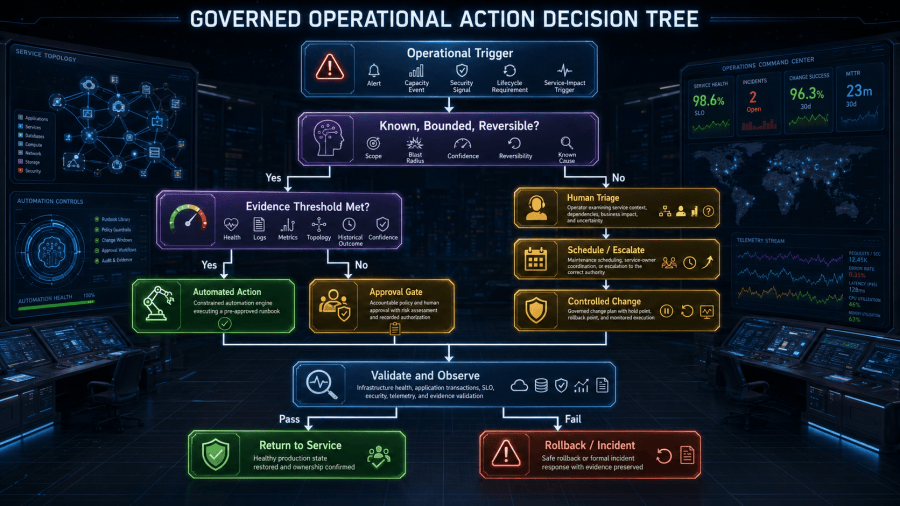
Not every operational action deserves the same authority. Mature teams classify changes by risk, reversibility, blast radius, and evidence.
Green-Lane Actions
Green-lane actions are low risk, bounded, observable, and reversible. Examples may include collecting diagnostics, synchronizing inventory, scaling within an approved range, or executing a well-tested corrective workflow against a narrow target.
The important point is not the specific action. It is the evidence boundary. An action belongs in the green lane only after the team has proven the trigger, preconditions, success criteria, and rollback behavior.
Amber-Lane Actions
Amber-lane actions are repeatable but need human approval because they affect availability, capacity, identity, security, or shared dependencies. Certificate changes, host remediation, cluster expansion, policy changes, and selected lifecycle tasks often fit this class.
Automation should prepare the change, validate prerequisites, calculate impact, and present evidence. A person still authorizes execution.
Red-Lane Actions
Red-lane actions have broad blast radius, weak reversibility, unclear dependencies, or limited production evidence. Major version transitions, management-plane redesigns, identity-source changes, destructive storage operations, and wide network changes should enter a formal change and recovery process.
The objective is not to keep red-lane work manual forever. The objective is to avoid pretending that a scripted action is automatically a low-risk action.
Automation, Telemetry, and Decision Rights
The race team works because sensing, deciding, and acting are connected but not confused.
Telemetry Establishes Conditions
VCF Operations can bring together infrastructure health, diagnostics, capacity, performance, network visibility, and logs. The platform team should use that visibility to define operational signals, not simply display more dashboards.
Every alert should answer three questions:
- What service or platform capability is at risk?
- What evidence supports the condition?
- What response class is permitted?
An alert that cannot influence a decision is noise.
Automation Executes Policy
Automation should implement a decision that the organization has already made. It should not invent policy at runtime. The workflow needs explicit inputs, prechecks, credentials, target scope, timeouts, error handling, validation, and a safe stop condition.
For VCF, the API-first direction and broader SDK coverage create useful options for Python, Java, PowerCLI, and Terraform. The platform team should choose tools based on ownership and lifecycle, not personal preference alone.
A PowerCLI command used interactively by an engineer may be appropriate for investigation. The same operation used at fleet scale may require an API-backed service, a controlled pipeline, or a workflow with durable state and approval.
Decision Rights Preserve Accountability
A unified platform does not eliminate organizational boundaries. Security still owns security policy. Application teams still own service acceptance. Infrastructure specialists still understand failure domains. Change authority still needs a named owner.
The operating model should make authority visible:
| Decision | Accountable role | Execution role | Required evidence |
|---|---|---|---|
| Approve a standard service | Platform owner | Platform engineering | Design, support, cost, security, lifecycle |
| Trigger low-risk remediation | Operations owner | Automation service | Known condition, narrow scope, rollback |
| Change shared network policy | Network or security owner | NSX operations | Dependency map, policy review, validation |
| Perform platform lifecycle change | VCF service owner | Lifecycle team | Compatibility, backup, sequence, maintenance plan |
| Accept workload recovery | Application owner | Application and platform teams | Service checks and business validation |
Speed improves when these decisions are known before the incident or change window begins.
Lifecycle Management Is Race Preparation
The pit stop starts long before the vehicle enters the lane. The same is true for VCF lifecycle management.
An upgrade plan needs an accurate inventory, supported source and target versions, dependency sequencing, resource requirements, network prerequisites, backup verification, maintenance windows, rollback criteria, and application validation. VCF 9.1 provides updated lifecycle capabilities and an upgrade-planning tool that can generate environment-specific phases, but the organization still owns the operational readiness around the plan.
A lifecycle workflow should therefore include four gates.
Readiness Gate
Confirm current versions, health, capacity, credentials, certificates, backups, interoperability, known issues, and required resources. Resolve degraded conditions before introducing change.
Sequence Gate
Document the order of management and infrastructure components. Include pauses where health, connectivity, and service behavior must be validated. Do not treat a multi-component platform upgrade as one opaque task.
Recovery Gate
Define the last safe rollback point for every phase. Confirm who can declare failure, who owns restoration, and what evidence must be retained.
Acceptance Gate
Validate more than component status. Confirm platform services, network paths, storage policy, authentication, automation integrations, monitoring, backup, and representative workloads.
The upgrade is complete only when the operating model is restored, not when the final installer exits.
Building the Team Around the Platform
A race team has specialists, but they share one operational objective. Private cloud teams often have specialists without a shared service model.
A practical VCF operating team usually needs the following responsibilities, even when one person holds more than one role:
- Platform product owner: defines service outcomes, roadmap, support boundaries, and investment priorities.
- VCF platform engineering: builds fleet standards, automation, service templates, lifecycle workflows, and recovery patterns.
- Compute, storage, and network specialists: own domain design, failure analysis, capacity, and complex remediation.
- Identity and security: own access models, certificates, secrets, policy, exceptions, and audit evidence.
- Service reliability or operations: owns monitoring quality, incident coordination, runbooks, operational reviews, and SLO reporting.
- Application teams: provide workload requirements, dependency context, test cases, and business acceptance.
- Change authority: approves actions that exceed bounded operational policy.
The platform team should not become a ticket-processing layer between consumers and infrastructure specialists. Its job is to convert specialist knowledge into dependable services and reusable operating patterns.
Metrics That Measure Operational Pace
Infrastructure uptime alone does not reveal whether the operating model is improving. A platform can remain technically available while delivery slows, alerts multiply, upgrades stall, and manual effort increases.
A useful scorecard includes:
- time from service request to validated delivery
- percentage of services delivered through supported templates
- mean time to detect, diagnose, and restore
- percentage of alerts tied to a defined response
- automated remediation success and rollback rate
- change failure rate by risk lane
- configuration drift and certificate-expiration exposure
- capacity headroom by failure domain
- lifecycle readiness and upgrade completion time
- platform SLO and representative workload SLO attainment
- percentage of operational actions with retained evidence
These metrics should be reviewed together. Driving one metric in isolation can create the wrong behavior. Faster change with a rising failure rate is not improvement. Fewer alerts achieved by disabling visibility is not operational maturity.
A Practical Adoption Path
Organizations do not need to redesign the full operating model at once. They need to close one valuable loop and then expand.
Define the Fleet and Service Boundary
Inventory the VCF components, management services, workload domains, external dependencies, owners, and supported service types. Establish what the platform team operates and what remains owned elsewhere.
Establish a Trustworthy Operational Baseline
Connect health, metrics, logs, diagnostics, capacity, identity, certificates, backup status, and lifecycle inventory. Remove monitoring that has no owner or action path.
Productize One Common Service
Choose a high-volume request such as a standard virtual machine environment, Kubernetes namespace, network segment, or application landing zone. Define policy, inputs, quotas, observability, validation, ownership, and retirement.
Build the Execution Pipeline
Use supported interfaces and store automation in version control. Add prechecks, change records, secrets handling, idempotence where practical, error reporting, validation, and rollback.
Introduce Risk Lanes
Classify operational actions as green, amber, or red. Start with advisory automation, then add approved execution for low-risk cases. Expand authority only after evidence shows reliable behavior.
Integrate Lifecycle Work
Treat patches, upgrades, certificate rotation, password rotation, backup validation, and recovery testing as recurring platform capabilities. Connect them to the same telemetry and evidence model used for incidents and service delivery.
Review the Operating Loop
After incidents, failed changes, and major lifecycle events, update the baseline, runbook, template, policy, or automation. The output of the review should improve the system, not merely document the meeting.
Caveats and Failure Modes
The race-team metaphor is useful, but it can hide several enterprise realities.
A Single Console Does Not Create a Single Team
Centralized visibility can expose organizational fragmentation without resolving it. Ownership, escalation, and authority still need explicit agreements.
Automation Amplifies Weak Standards
A poorly defined service delivered automatically is still a poorly defined service. It simply reaches more consumers faster.
Telemetry Can Create False Confidence
Dashboards are only as reliable as their collection, topology, thresholds, retention, and ownership. Validate that monitoring covers management dependencies and service outcomes, not only healthy infrastructure objects.
Lifecycle Plans Are Environment Specific
Version paths, component combinations, integrations, hardware, and operational constraints change the required sequence. Use current documentation and planning tools, then validate the resulting plan against the actual environment.
Self-Service Needs Limits
Quotas, policy, network boundaries, identity, cost ownership, naming, data protection, and retirement must be part of the service. Without them, self-service becomes unmanaged demand.
Not Every Remediation Should Be Autonomous
Novel failures, uncertain diagnoses, wide blast radius, and destructive actions require human judgment. Bounded autonomy is a maturity outcome, not a starting assumption.
Conclusion
The image is not really about motorcycles. It is about the operating system behind sustained speed.
VMware Cloud Foundation can centralize important capabilities for fleet management, infrastructure operations, lifecycle management, diagnostics, automation, and programmable infrastructure. The platform becomes strategically useful when those capabilities are connected to a disciplined operating model.
That model observes conditions, correlates evidence, classifies risk, executes through supported paths, validates service outcomes, and improves the standard for the next event. It allows specialists to preserve authority while turning their knowledge into repeatable services. It makes upgrades planned interventions instead of improvised maintenance. It makes automation a policy-execution mechanism instead of a collection of scripts.
The practical next step is to choose one high-value operational loop and engineer it end to end. Define the signal, owner, decision, workflow, validation, rollback, and evidence. When that loop is dependable, expand it.
High-performance private cloud operations are not created by moving faster during the incident. They are created by making fewer uncertain decisions when the incident arrives.