AI Assistant Decision Series | Part 5 of 6 | Product and source baseline: October 19, 2026.
TL;DR
Building applications with GPT, Claude, Gemini, Grok, and Meta models involves substantially more than choosing an inference API. All five ecosystems support programmatic access to language models and structured tool use, but they differ in agent runtimes, SDK conventions, MCP integration, execution environments, model hosting, observability, and commercial arrangements.
OpenAI provides the Responses API, Agents SDK, and managed Agents API. Anthropic offers the Claude Messages API, direct tool use, MCP connectivity, and Claude Managed Agents. Google combines the Gemini APIs with its Agent Development Kit (ADK) and managed Agent Runtime. xAI supports Grok through native and OpenAI-compatible APIs, including built-in tools and remote MCP integration. Meta now provides the hosted Meta Model API and Muse Code alongside downloadable Llama models, Muse Glimmer, and the newly released Muse Spark Open.
A multi-model architecture can improve flexibility, but portability is not automatic. An OpenAI-compatible endpoint may simplify a request while leaving agent state, tool authorization, caching, retrieval, reasoning controls, tracing, and deployment fundamentally different. Organizations need a stable application contract above the model providers and explicit ownership of the controls around them.
Key takeaway: Standardize the business contract, authorization, evidence, and operating model. Adapt each vendor’s implementation without pretending the underlying platforms are interchangeable.
Introduction
An enterprise development team has been asked to build an AI assistant that can investigate infrastructure incidents.
The assistant must retrieve monitoring information, read support tickets, consult approved runbooks, produce a technical explanation, and draft a remediation plan. Eventually, it may be allowed to create change requests or perform tightly controlled operational actions.
The initial prototype uses one vendor’s API and works well.
Then the requirements change.
The architecture team wants a second model provider for resilience. Security wants all tool calls evaluated independently. Finance wants lower-cost models for routine classification. Platform engineering wants deployment choices across managed cloud services and private infrastructure. The development team wants to reuse its application logic without rewriting the entire agent.
The original design exposes an uncomfortable dependency: the application has absorbed the provider’s API semantics, conversation state, tool-call format, SDK behavior, and error handling.
Changing the model now means changing the application.
This is a common failure mode in enterprise AI development. Teams believe they are integrating a language model, but they are gradually adopting a complete vendor-specific runtime.
The distinction matters because the five ecosystems are developing along different technical paths.
OpenAI and Anthropic offer direct APIs alongside increasingly sophisticated agent execution systems. Google integrates model development with broader managed cloud infrastructure. xAI combines conventional model access with server-executed search and computation tools. Meta now spans hosted frontier APIs and substantially different open-weight deployment options.
Part 1 of this series explained the ecosystems. Part 2 compared capabilities. Part 3 identified strongest candidates for particular tasks. Part 4 examined privacy, identity, agent authorization, retention, and governance.
This fifth article focuses on the engineering consequences.
The objective is to compare official developer interfaces, model execution, MCP support, agent orchestration, hosted and self-hosted deployment, portability, cost, and Day-2 operations. It also provides a practical reference architecture and a vendor-neutral implementation pattern.
This is not an independently validated performance benchmark or a claim that the examples have been deployed in production. The technical examples are implementation starting points, with their scope and verification requirements explicitly identified.
Compare Developer Platforms, Not Chat Applications
The relevant comparison is the programmatic surface through which an application accesses a model, controls tools, manages state, and executes workflows.
The five ecosystems support broadly similar application goals, but they expose different responsibilities.
| Ecosystem | Primary model API | Agent development and execution | Model deployment |
|---|---|---|---|
| OpenAI GPT | Responses API | Agents SDK and managed Agents API | Vendor-managed model inference; application and sandbox hosting options |
| Anthropic Claude | Messages API | Claude Agent SDK and Claude Managed Agents | Anthropic API and supported cloud-provider distribution |
| Google Gemini | GenerateContent and Interactions APIs | Agent Development Kit, Antigravity, managed Agent Runtime | Google-hosted Gemini inference with several application-runtime choices |
| xAI Grok | Responses API and supported compatible interfaces | Native SDK, built-in tools, custom agent loops; Grok Bot as a separate product | xAI-managed inference and supported cloud distribution |
| Meta | Meta Model API, with Responses, Chat Completions, and Messages interfaces | Muse Code, supported agent frameworks, custom tool loops | Hosted Muse models; downloadable Llama, Muse Glimmer, and Muse Spark Open models |
Scope: These are documented developer offerings, not claims that the five systems provide equal functionality or deployment control. Feature compatibility must be verified against the selected model, endpoint, and account.
The Current Model Baseline
For concrete examples, the following are documented model identifiers available in the respective developer ecosystems at the October 19, 2026 baseline.
| Provider | Representative model identifier | Evaluation role |
|---|---|---|
| OpenAI | gpt-6.1-sol |
Complex professional tasks with a balance of cost and capability |
| Anthropic | claude-sonnet-5-5 |
General software engineering and agent workloads |
gemini-3.8-flash |
High-throughput, multimodal, and agent-oriented development | |
| xAI | grok-4.7 |
Coding, reasoning, and tool-connected applications |
| Meta | muse-spark-1.3 |
Hosted multimodal and agent development |
These identifiers are examples, not a performance-equivalent test set.
The models do not have identical reasoning budgets, multimodal support, context behavior, tokenization, latency, or cost.
OpenAI’s GPT-6 Astra, Anthropic’s Claude Fable, Google’s Gemini 4 Argon, and Meta’s Muse Wonder serve more demanding workload segments. Choosing a more expensive model can be justified when accepted task quality improves sufficiently, but the model itself should be selected through evaluation rather than brand hierarchy.
One important lifecycle detail is that Google’s earlier gemini-3.5-flash identifier is deprecated and routed to a replacement model. New integrations should not depend on historical aliases without recording the actual effective version.
OpenAI: Responses API, Agents SDK, and Managed Agents API
OpenAI offers three related but distinct paths for application development.
Responses API
The Responses API is the appropriate starting point for direct model interaction and workflows where application code owns the sequence of decisions.
It supports structured model outputs, function calling, and model-compatible hosted tools. Those tools can include search, file retrieval, code execution, and MCP integrations.
The application can decide which capabilities are exposed and handle tool execution where required.
This is useful for bounded services such as ticket classification, document extraction, technical summarization, and evidence-backed analysis.
The tradeoff is that the application must implement its own orchestration, durable business state, authorization, retries, and operational recovery when the workflow becomes more complex.
Agents SDK
The OpenAI Agents SDK adds a code-first orchestration layer.
It provides agent definitions, tool integration, handoffs, guardrails, sessions, and tracing. The SDK operates inside an application-controlled runtime, allowing developers to integrate existing services and define where state and execution occur.
An infrastructure operations assistant might use a research agent to retrieve evidence and a separate drafting agent to prepare a change request.
The SDK can coordinate those model interactions, but the application must still authorize operations against the ticketing or infrastructure system.
That distinction is critical. A guardrail inside the orchestration framework should not be the only enforcement mechanism protecting production resources.
Managed Agents API
The managed Agents API provides a different execution model.
OpenAI manages the underlying agent harness and persistent session infrastructure, with options for hosted or customer-managed execution environments.
This can reduce development effort for long-running tasks involving files, code, tools, and multi-step work.
The tradeoff is greater dependence on the provider’s runtime conventions, session lifecycle, tracing, and supported execution surfaces.
Architecture decision: Use Responses for simple or tightly controlled model calls, Agents SDK when the enterprise needs to own orchestration logic, and the managed Agents API when managed execution provides sufficient benefit to justify its service dependencies.
Anthropic: Messages API and Claude Agent Execution
Anthropic’s core model interface is the Messages API.
Applications submit conversation messages and receive structured content blocks. Those blocks can contain text, tool-use requests, and other supported model-specific information.
The distinction between text output and tool-use blocks is important when building applications.
A Claude tool call identifies the requested operation and its structured arguments. If the tool is client-executed, the application runs it and returns a tool-result block. Anthropic also offers server-executed tools for supported operations.
This makes execution ownership explicit.
Claude Agent SDK
The Claude Agent SDK provides a higher-level environment for building tool-using agents around application and development workflows.
It supports the broader capabilities associated with agent execution, including file operations, shell-based work, tool permissions, hooks, and supported MCP integrations.
This is an appropriate candidate when the development problem involves repositories, development tools, filesystem operations, or other tasks requiring an explicit execution environment.
It should still be operated inside a suitable security boundary.
A shell-capable coding agent is a privileged workload. Its deployment needs repository restrictions, ephemeral or controlled credentials, network policy, approved commands, and auditable changes.
Claude Managed Agents
Claude Managed Agents adds a managed session and execution environment.
The service supports agent definitions, tools, connected MCP servers, and session-specific credentials. Anthropic’s documentation separates reusable agent configuration from secrets provided to particular sessions.
That separation can make credential management easier, especially when a common agent definition serves several users.
However, Anthropic documents Managed Agents and certain MCP features as beta capabilities. The production decision must account for current feature status, model compatibility, data retention, and the specific service agreement.
Deployment Through Other Cloud Providers
Anthropic documents availability of current Claude models through its own API and supported services from Amazon Web Services, Google Cloud, and Microsoft.
This provides procurement and integration alternatives, but distribution through a cloud provider does not mean the model weights are delivered for independent hosting.
Architecture decision: Claude is a strong candidate when a workload needs structured tool use, code-oriented execution, or a managed agent service. Choose the API or agent runtime according to the required execution and credential boundaries, not simply the model family.
Google: Gemini APIs, ADK, and Enterprise Agent Runtime
Google’s developer environment has a broad separation between model access, agent development, and managed deployment.
GenerateContent and Interactions APIs
Google’s Gemini API supports model inference, multimodal inputs, structured results, and function calling.
The newer Interactions API introduces a different model for stateful interactions, tools, and agent-oriented workflows.
The interfaces are not functionally identical. Google’s Interactions API overview lists Batch API, Python automatic function calling, and explicit caching as GenerateContent capabilities not yet available in Interactions. Implicit caching is available in Interactions. The Interactions API reference documents safety_settings, including harm-category and blocking-threshold controls.
Developers should select an API based on the features required rather than assume the newer interface supersedes every existing behavior.
Agent Development Kit
Google’s Agent Development Kit (ADK) provides a code-first framework for creating agents with tools, workflows, sessions, and multi-agent coordination.
It supports Python, TypeScript, Go, and Java.
A development team can use ADK to define a workflow that validates an incoming request, invokes retrieval tools, uses a model to prepare an answer, and routes the output through an independent approval stage.
ADK provides the agent orchestration capability. It does not remove the need to design data permissions, secrets management, application state, or incident handling.
Gemini Enterprise Agent Runtime
Google’s managed Agent Runtime provides deployment infrastructure for agents.
Supported deployment methods include application source, containers, connected repositories, and framework-based deployment workflows.
This can be attractive to organizations already using Google Cloud because the surrounding infrastructure can integrate with Google Cloud identity, networking, logging, monitoring, and deployment services.
The cloud platform also supports agent evaluation, managed sessions, and enterprise governance capabilities.
The tradeoff is that cloud-native integration may create substantial dependency on Google-specific runtime and management services.
An ADK agent can be portable as application code while still relying on platform-specific session storage, identity, tool configuration, or monitoring.
Architecture decision: Use Gemini APIs for direct inference, ADK for agent development, and managed Agent Runtime when Google Cloud operational integration and lifecycle services justify the dependency.
xAI provides programmatic access to Grok models through its API and SDK ecosystem.
The current Grok 4.7 documentation identifies the Responses API as its principal interface and documents function calling, configurable reasoning, and structured outputs.
The platform distinguishes client-executed functions from server-executed tools.
Built-In Tools
xAI documents built-in capabilities including Web Search, X Search, code execution, and collections-based retrieval.
These tools create an important architectural distinction.
A developer can let the provider execute a supported search operation, receiving the result as part of the model workflow. Alternatively, the enterprise can build its own retrieval service and return results to Grok through controlled function calls.
The first approach may reduce integration effort. The second provides greater control over source selection, access policy, logging, and the data returned to the model.
The correct choice depends on the sensitivity and provenance requirements of the workload.
SDK and Compatible Interfaces
xAI supports its native SDK and OpenAI-compatible developer interfaces.
This can reduce development effort for applications already using familiar Python or TypeScript model clients.
However, compatibility must be verified per endpoint, model, and feature.
A working text-generation call does not establish that reasoning parameters, custom tools, citations, streaming events, or server-side functions behave identically.
Grok Bot Is a Separate Execution Surface
Grok Bot provides a more persistent agent-oriented experience with cloud-based execution and connected applications.
It should not be treated as the same product as a direct xAI API request.
The difference matters for identity, task persistence, shared computer state, audit logging, subscriptions, and operational support.
Architecture decision: Grok deserves evaluation for applications that benefit from X Search, supported server-side tools, real-time interactions, and API-based agent workflows. The enterprise must distinguish provider-executed tools from its own authorized business operations.
Meta now requires a more detailed architecture comparison than simply identifying Llama as an open-weight alternative.
As of October 19, 2026, Meta provides several developer paths with different deployment and licensing implications.
Hosted Meta Model API
Meta Model API provides hosted access to Muse models, including Muse Spark and Muse Wonder.
The API supports OpenAI-compatible Responses and Chat Completions formats, as well as an Anthropic Messages-compatible interface.
This allows developers to reuse familiar SDKs for supported operations.
Meta documents tool calling, structured responses, streamed tool arguments, prompt caching, and several multimodal capabilities.
Muse Wonder is in preview through Model API. Muse Wonder Full is a separate higher-capability offering available through qualifying Muse Code subscriptions, not a model that can be selected interchangeably through the ordinary pay-as-you-go API.
Muse Code
Muse Code provides a terminal-oriented coding agent.
It supports repository work, shell execution, approvals, sandboxing, reusable skills, and MCP connections.
This is a separate agent execution product, not merely another name for Meta Model API.
Developers must account for its execution environment, installation lifecycle, permissions, and any automation or subscription conditions.
Llama
Meta’s Llama family includes downloadable model weights that can be deployed through compatible inference runtimes.
This provides an option for organizations that want greater control over model-serving infrastructure.
However, Llama models are subject to their specific community licenses and acceptable-use requirements. The availability of weights does not establish unrestricted open-source licensing or suitability for every use case.
Muse Glimmer
Meta describes Muse Glimmer as a 30-billion-parameter open-weight model optimized for local and edge-oriented agent workflows.
Its Apache 2.0 license is materially different from the licensing arrangements used by some other Meta model families.
It is worth considering when the workload requires a more constrained local deployment, but the enterprise must validate the supported hardware, runtime, latency, and task quality.
Muse Spark Open
On October 15, 2026, Meta released Muse Spark Open.
The published model is an 816-billion-parameter mixture-of-experts system with approximately 42 billion active parameters per token.
Meta documents BF16 and NVFP4 checkpoints and supports deployment through runtimes such as SGLang and vLLM, as well as access through selected hosted inference providers.
This creates a substantially different infrastructure decision from consuming Muse Spark through Meta Model API.
Meta’s documented BF16 reference weights occupy approximately 1.65 TB. The NVFP4 checkpoint is approximately 537 GB, with additional memory required for runtime overhead and key-value caches.
Self-hosting therefore requires significant capacity planning. A smaller active-parameter count does not eliminate the memory required to load the model’s full weights.
Muse Spark Open is distributed under the Muse Model License, not the Apache 2.0 license used by Muse Glimmer.
Architecture decision: Meta offers one of the clearest choices between hosted frontier model access and downloadable model deployment within this five-vendor comparison. However, Muse Model API, Muse Code, Muse Spark Open, Muse Glimmer, and Llama have different technical and legal boundaries.
All five hosted developer ecosystems can generate structured requests to invoke tools.
That does not mean a model should be allowed to execute any requested operation.
The engineering responsibility is to distinguish the model’s request from the application’s authorization and execution decisions.
How a Tool-Using Transaction Should Work
The following is a recommended architecture for enterprise-controlled tool execution. Individual vendors may use different API message formats, but the control boundary should remain visible.
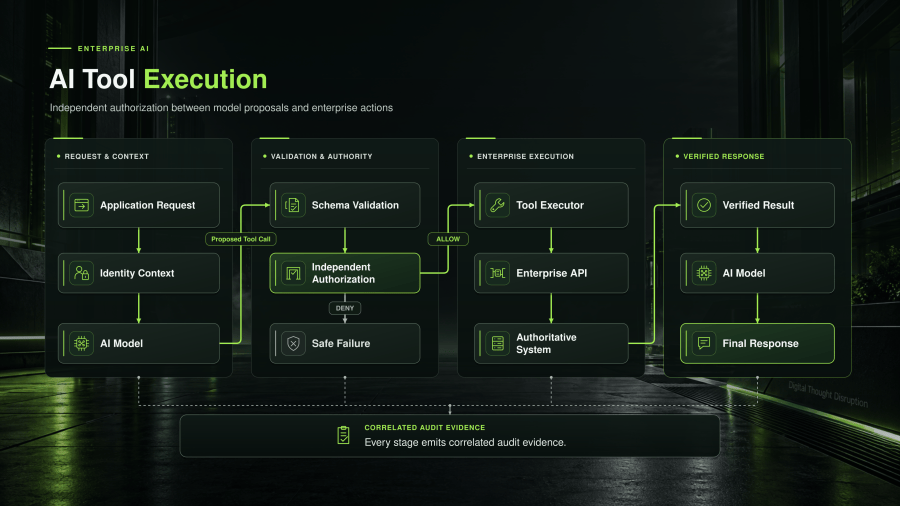
A model may request a tool called create_change_request, with arguments describing a service, intended change, and proposed execution window.
That request must be treated as untrusted input.
The application should validate the JSON schema, authenticate the effective requester, check the requested operation against policy, and determine whether approval is required.
Only then should the tool executor call the authoritative system.
This separation becomes especially important when the application changes model providers. The model can be replaced without changing the enterprise’s authorization policy or the implementation of the business operation.
Client-Executed and Server-Executed Tools
| Execution pattern | Typical use | Control responsibility |
|---|---|---|
| Client-executed function | Internal APIs, sensitive databases, production systems | Enterprise application executes and authorizes the operation |
| Provider-executed tool | Supported search, retrieval, code execution, or hosted capabilities | Provider manages execution; enterprise controls enablement and permitted scope |
| Remote MCP connection | Approved reusable enterprise or external tools | MCP client/server integration plus enterprise identity and policy |
| Computer or browser agent | Variable workflows requiring interface interaction | Execution environment, permissions, approvals, and session controls |
| Managed agent runtime | Long-running tasks with persistent state | Shared responsibilities between provider and enterprise, depending on service |
The difference is not merely performance.
A server-executed search tool may reduce engineering effort, but it also changes where retrieval logic and intermediate data processing occur.
A client-executed function requires more application code, but it allows the organization to keep policy enforcement and business-system credentials within its own environment.
Neither is automatically preferable. The workload’s data, latency, support, and security requirements determine the appropriate pattern.
MCP Support: Similar Protocol, Different Implementation
Model Context Protocol provides a common way for AI applications to discover and invoke capabilities supplied by MCP servers.
It can reduce the amount of custom integration code needed when an organization supports multiple models and agent frameworks.
However, MCP is not an enterprise authorization system by itself.
A standard tool description does not establish who is allowed to invoke the tool, whether the operation is permitted, or how the resulting business transaction should be audited.
Cross-Vendor MCP Integration Matrix
| Ecosystem | Documented MCP approach | Material qualification |
|---|---|---|
| OpenAI | Remote MCP in Responses; Agents SDK integration; private-server connectivity through Secure MCP Tunnel; managed-agent MCP connections | Supported transport, tool approvals, session environment, and exposure differ by runtime |
| Anthropic | Remote MCP connector in Messages API; SDK-side MCP helpers; Claude Managed Agents MCP integrations | Direct connector supports tools, not the full MCP feature set; beta and retention limitations apply |
| MCP integrations in ADK; remote MCP configuration documented for Interactions API | Model and endpoint compatibility must be checked; official documentation retains a conflicting Gemini 3 limitation | |
| xAI | Remote MCP tools through supported SDK and Responses interfaces | Supported transports include Streamable HTTP and SSE; some OpenAI-compatible approval parameters are unsupported |
| Meta | Muse Code supports MCP servers using local stdio or Streamable HTTP; Meta Model API supports function calling | Do not assume the hosted Model API provides the same native remote MCP behavior as Muse Code |
These are product-specific capabilities, not identical implementations of every MCP specification feature.
OpenAI: Multiple MCP Connection Paths
OpenAI’s Responses API supports remote MCP connections. The developer documentation also describes Secure MCP Tunnel for reaching supported local or private MCP services.
The managed Agents API offers additional connection options through the service or the agent’s execution environment.
These differences affect network reachability, credentials, tool approval, and operational ownership.
A private MCP server connected through a managed session is not the same architecture as a publicly reachable remote MCP endpoint, even when both expose the same tools.
Anthropic: Direct MCP Connector and Client-Side Helpers
Anthropic’s Messages API MCP connector supports remote servers using supported HTTP transports.
Its documentation identifies the direct connector as a tool-oriented integration. Features such as local stdio access, MCP resources, and prompts require a client implementation or appropriate SDK helpers.
The direct connector is documented as ineligible for zero data retention.
For enterprise use, that restriction may affect whether the direct connector can be adopted or whether the application must run its own MCP client.
Google: A Model-Specific Documentation Conflict Requires Validation
Google documents remote MCP support through the Interactions API, including configurations for Streamable HTTP servers and allowed tool lists.
However, Google’s Interactions API overview, updated October 15, 2026, still states that Gemini 3 does not support remote MCP and that availability is forthcoming.
These statements cannot be treated as a universal guarantee of support for every Gemini 3-series model.
The practical requirement is to verify the actual model identifier, endpoint, SDK version, and MCP operation before accepting the integration.
Google ADK also provides a separate path for integrating MCP tools within an application-controlled agent workflow.
For a production deployment, choose the documented and tested path rather than relying on an assumed equivalence between the model API and ADK.
xAI: Remote MCP With Important Approval Differences
xAI supports remote MCP tools through its native SDK and supported Responses interfaces.
The documentation identifies Streamable HTTP and SSE transport support, with configuration for permitted tools and authentication.
It also states that some parameters supported in OpenAI-style integrations, including require_approval, are not currently supported by xAI’s compatible interface.
That creates a consequential difference.
An application designed around another provider’s automatic MCP approval behavior must not assume xAI will enforce the same setting.
External authorization should remain authoritative.
Meta: MCP Is Established in Muse Code, Not Universally Across Every API
Muse Code supports MCP server configuration, including local process transport and remote HTTP connections.
Its documentation describes MCP authentication, permitted tools, and integration with agent execution.
Meta Model API supports structured function calling, but the examined documentation does not establish an identical hosted remote MCP feature across all its model interfaces.
A developer can integrate an independent MCP client into an application using Meta models. That is different from the hosted model service executing MCP calls on the application’s behalf.
The distinction should be preserved in the implementation design.
A production MCP implementation needs five controls.
First, the client must authenticate to the intended MCP server using an approved identity. For remote servers, the MCP authorization specification defines an OAuth-based model.
Second, the MCP server must authorize the requested capability, rather than trusting the model’s assertion that it may perform the operation.
Third, tool arguments must be validated against the operation’s schema and business rules.
Fourth, high-impact changes require independent approval, transaction constraints, and post-execution verification.
Finally, both the tool request and the authoritative system result must produce sufficient evidence for troubleshooting and audit.
A practical enterprise MCP gateway should also maintain an allowlisted tool registry, approved server versions, permitted network destinations, and a means to disable tools during an incident.
MCP makes tools easier to connect. That increases the importance of governing what those tools can do.
The Reference Architecture: Keep the Enterprise Contract Above the Models
A multi-provider application should not expose every provider-specific capability directly to business workflows.
A more sustainable approach separates the application, orchestration, model access, retrieval, and tool execution responsibilities.
The architecture below is a proposed reference design, not a deployment diagram for one particular vendor.
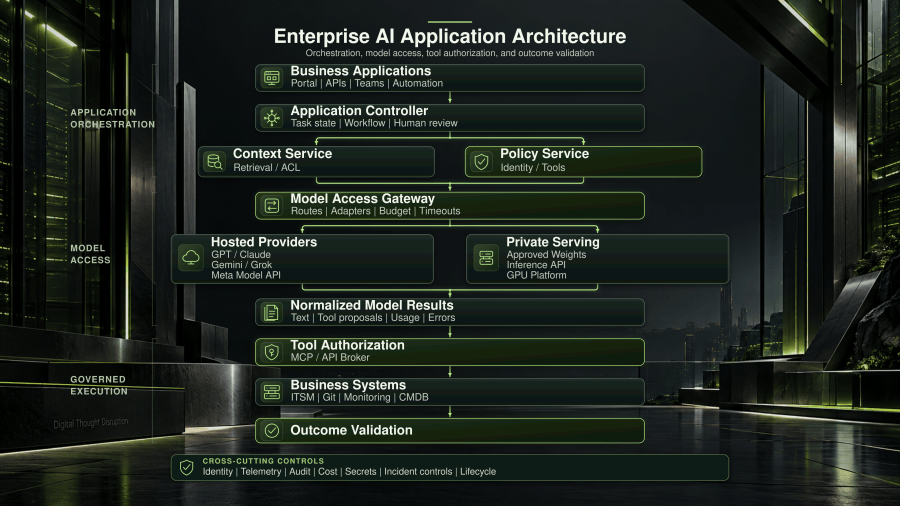
ACL: access control list. ITSM: IT service management. CMDB: configuration management database.
The most important separation is between model selection and business-system authority.
The model gateway chooses an approved provider. It does not independently grant permission to retrieve restricted information or execute a business transaction.
The application controller owns workflow state and knows whether a proposed action has been accepted. The policy service evaluates access independently. The tool broker executes only authorized operations.
This structure makes provider replacement possible without automatically changing the application’s privilege model.
Define Which Responsibilities Are Portable
| Concern | Recommended ownership | Portability expectation |
|---|---|---|
| Business task and outcome | Application controller | High |
| Identity and authorization | Enterprise security services | High |
| Retrieval and source ACLs | Governed context service | High, if interface is controlled |
| Model selection | Model gateway | High at routing level |
| Model request and output syntax | Provider adapter | Moderate |
| Reasoning and tool-call behavior | Selected model | Low to moderate |
| Agent session state | Application or managed runtime | Depends on storage and runtime |
| Server-hosted tools | Provider | Low |
| Business APIs and MCP servers | Enterprise tool layer | High with stable contracts |
| Evaluation and acceptance | Enterprise testing system | High |
| Usage and cost interpretation | Normalized telemetry service | Moderate |
| Model weights and serving | Model-specific infrastructure | Highly variable |
Do not spend months trying to make every feature portable.
The goal is to keep application outcomes, permissions, records, and critical operational processes replaceable.
Vendor-specific optimizations can remain inside clearly defined adapters.
Implement a Multi-Provider Adapter Without Hiding the Differences
The safest starting point for portability is a narrow, read-only contract.
Before connecting tools or building agents, prove that the application can call each approved provider, extract a usable response, report failures, and preserve provider-specific metadata.
Do not begin by attempting to replicate an entire agent framework across five SDKs.
Prerequisites
For a Python example, install the currently supported OpenAI, Anthropic, and Google GenAI client packages.
python -m pip install openai anthropic google-genai
Use an approved secrets-management mechanism to provide the credentials and endpoint settings required by each service.
| Provider | Required configuration |
|---|---|
| OpenAI | OPENAI_API_KEY |
| Anthropic | ANTHROPIC_API_KEY |
GEMINI_API_KEY |
|
| xAI | XAI_API_KEY, XAI_BASE_URL |
| Meta | META_MODEL_API_KEY, META_MODEL_BASE_URL |
The endpoint variables for xAI and Meta must contain the documented API base addresses. Configure them outside application source code using the verified vendor documentation.
Use development credentials with appropriate usage limits. Do not paste keys into source files, chat transcripts, or source control.
A Read-Only Python Provider Adapter
The following example uses documented client interfaces and representative current model identifiers.
It accepts a provider name and a text request, sends one inference call, and returns the text output. It does not expose tools, execute business operations, maintain agent memory, or perform automatic fallback.
"""Read-only smoke test, not a production agent."""

import os

from openai import OpenAI
from anthropic import Anthropic
from google import genai


MODELS = {
    "openai": "gpt-6.1-sol",
    "anthropic": "claude-sonnet-5-5",
    "google": "gemini-3.8-flash",
    "xai": "grok-4.7",
    "meta": "muse-spark-1.3",
}


def generate_text(provider: str, prompt: str) -> str:
    """One text response; no tools or agent state."""
    if provider not in MODELS:
        raise ValueError(f"Unsupported provider: {provider}")

    model = MODELS[provider]

    if provider == "openai":
        response = OpenAI().responses.create(
            model=model,
            input=prompt,
        )
        text = response.output_text
    elif provider == "anthropic":
        response = Anthropic().messages.create(
            model=model,
            max_tokens=700,
            messages=[
                {"role": "user", "content": prompt}
            ],
        )
        text = "".join(
            b.text
            for b in response.content
            if b.type == "text"
        )
    elif provider == "google":
        response = genai.Client().models.generate_content(
            model=model,
            contents=prompt,
        )
        text = response.text
    else:
        prefix = (
            "XAI" if provider == "xai"
            else "META_MODEL"
        )
        client = OpenAI(
            api_key=os.environ[f"{prefix}_API_KEY"],
            base_url=os.environ[f"{prefix}_BASE_URL"],
        )
        response = client.responses.create(
            model=model,
            input=prompt,
        )
        text = response.output_text

    if not text:
        raise RuntimeError(
            "No text response; inspect provider result"
        )

    return text


if __name__ == "__main__":
    target = os.getenv("AI_PROVIDER", "openai")
    print(generate_text(
        target,
        "Explain two risks in a VM change plan."
    ))
The example’s Python syntax has been checked. Live calls against the five APIs have not been executed or verified.
What the Example Actually Demonstrates
The adapter exposes a stable application function while using provider-specific client behavior internally.
OpenAI and the compatible xAI and Meta interfaces use a Responses-style request.
Claude uses the Messages API and requires extraction of text from structured content blocks.
Google uses the GenAI client and a GenerateContent call.
The application receives a text result through one shared function, while the provider-specific request construction remains isolated.
This is sufficient for a basic text-inference smoke test.
It is not sufficient for production portability.
What Must Be Added Before Production
A real provider adapter should preserve substantially more information than the text response.
| Requirement | Production handling |
|---|---|
| Model identity | Record the requested and effective model, including version |
| Usage | Normalize input, output, cached, and other billable usage |
| Errors | Classify authentication, quota, timeout, provider failure, and invalid response |
| Retries | Apply bounded retries where safe; respect rate-limit guidance |
| Tracing | Preserve correlation IDs, provider identifiers, and relevant spans |
| Tool calls | Normalize proposed actions without executing them automatically |
| Streaming | Preserve event ordering, partial-output state, and interruption handling |
| Structured outputs | Validate against the application’s JSON schema |
| State | Store authoritative workflow state outside the model response |
| Security | Apply approved data, model, region, and tool policies before dispatch |
| Cost | Record estimated and actual cost per request and accepted outcome |
The simple adapter also does not normalize multimodal inputs, reasoning-state replay, model refusals, citation metadata, background operations, or provider-specific session state.
Those omissions are intentional.
Trying to normalize everything at once can produce an abstraction that appears clean while silently discarding important behavior.
The correct approach is to add capabilities one at a time and introduce a corresponding compatibility test for each.
Expected Validation
The team should execute the same harmless prompt through each approved model and capture the model identifier, response, latency, usage metadata, and any errors.
A successful smoke test demonstrates that all configured interfaces are reachable and can return text.
It does not demonstrate that the models produce equivalent answers, that tool calling is portable, or that the workflow will behave consistently under failure.
Typical problems include an unavailable model entitlement, an incorrect base URL, missing credentials, response-format differences, quota restrictions, or an SDK version incompatible with the selected API.
For production, preserve the original provider response alongside the normalized output wherever policy allows. That makes unexpected behavior easier to diagnose without forcing every vendor’s metadata into an oversimplified schema.
Portability Has Four Different Levels
The term vendor-neutral is often used too broadly.
Portability should be evaluated at four distinct layers.
API Portability
This is the ability to change an endpoint, model identifier, or client configuration without rewriting the entire request workflow.
Meta Model API and xAI’s supported compatible endpoints demonstrate why this can be useful.
But identical client methods do not guarantee identical model capabilities.
Behavioral Portability
This concerns whether another model will produce acceptable outputs under the same instructions and data conditions.
Even when the JSON schema is unchanged, models can interpret tool descriptions, instructions, ambiguous requirements, and missing evidence differently.
Behavioral portability requires regression testing.
Agent Portability
This is the ability to move a workflow between orchestration environments without losing state, approval logic, scheduled work, tool permissions, and recovery behavior.
This is substantially more difficult than changing a model API.
An OpenAI Agents API session is not a Claude Managed Agents session or a Google Agent Runtime session.
The workflow may need a translation or migration process for stored messages, model-specific reasoning blocks, artifacts, credentials, and execution state.
Infrastructure Portability
This is the ability to deploy inference in a different hosting environment.
It is most relevant when the organization controls model weights or uses a provider that supports the same model through several cloud environments.
Moving application code to another cloud does not automatically move a proprietary hosted model.
Likewise, downloading an open-weight model does not mean it can run economically on existing enterprise hardware.
Portability Matrix
| Architecture element | Portability | Typical work required |
|---|---|---|
| Text request and response | Relatively high | Provider adapter and model validation |
| Structured JSON response | Moderate to high | Schema tests and refusal handling |
| Function calling | Moderate | Tool-call translation and execution-loop tests |
| Remote MCP | Conditional | Transport, permissions, authentication, and compatibility testing |
| Provider-hosted search | Low | Replace retrieval service or accept a different integration |
| Reasoning state | Low | Provider-specific handling or workflow reset |
| Agent memory and sessions | Low to moderate | State migration and lifecycle control |
| Managed-agent environment | Low | Runtime redevelopment or deployment adaptation |
| Business-tool execution | High if enterprise-owned | Stable APIs, MCP contracts, and independent policy |
| Self-hosted inference | Model-dependent | License, serving runtime, hardware, and lifecycle validation |
This is why a portability strategy should preserve interfaces that matter to the business, while accepting that some vendor-specific capabilities will remain specialized.
Model Hosting: Managed Inference Versus Downloadable Weights
The five ecosystems are not equally portable at the model-deployment layer.
Hosted APIs place much of the inference infrastructure responsibility with the provider. The enterprise retains responsibility for application architecture, data handling, integration, cost governance, and operational validation.
Self-hosted open-weight models transfer additional responsibility to the organization.
Deployment Comparison
| Ecosystem | Managed model inference | Enterprise-controlled application runtime | Independently hosted model weights |
|---|---|---|---|
| OpenAI GPT | Documented | Yes | Not offered for the proprietary GPT models compared here |
| Anthropic Claude | Documented, including supported cloud distribution | Yes | Not offered for the proprietary Claude models compared here |
| Google Gemini | Documented through Google services | Yes, including ADK deployment options | Not offered for the proprietary Gemini models compared here |
| xAI Grok | Documented through xAI and supported distribution channels | Yes | Downloadable Grok weights not established in the examined sources |
| Meta | Hosted Muse through Model API | Yes | Llama, Muse Glimmer, and Muse Spark Open provide downloadable options |
This table concerns the named model families, not every open-weight model developed by the same companies.
Google’s Gemma family, for example, is separate from the proprietary Gemini models discussed here.
Managed Inference Reduces Infrastructure Ownership
With hosted inference, the provider generally manages model-serving infrastructure, accelerator provisioning, internal model runtime, and service-level capacity.
The enterprise still has to manage:
- Application identity and network access.
- Model selection and version compatibility.
- Data classification, retention, and processing locations.
- Token and tool budgets.
- Error handling, fallback, and observability.
- Business-service recovery and operational support.
Hosted inference shifts responsibilities. It does not remove them.
Self-Hosted Weights Expand Control and Operational Responsibility
An organization hosting Llama, Muse Glimmer, or Muse Spark Open can determine where its inference infrastructure runs and how it integrates with approved systems.
However, it must also engineer accelerator capacity, storage, serving runtimes, networking, scheduling, monitoring, scaling, security, and recovery.
Model compatibility becomes an infrastructure concern. Drivers, accelerator memory, runtime versions, quantization, tokenization, and attention implementations can affect whether a model operates correctly and efficiently.
The Muse Spark Open example illustrates the scale difference.
Its published BF16 checkpoint requires approximately 1.65 TB for the weights alone. Even its smaller NVFP4 checkpoint represents a substantial accelerator-memory requirement.
A private deployment may be justified by workload volume, data location, cost, model customization, or strategic control. It should not be justified simply because the weights are downloadable.
Licenses Are Part of the Deployment Architecture
Meta’s downloadable model families use different licenses.
Muse Glimmer is released under Apache 2.0. Muse Spark Open uses the Muse Model License. Llama models are governed by applicable Llama Community License terms.
These distinctions affect commercial rights, redistribution, derivatives, attribution, and other obligations.
A project should record the exact model artifact, model version, license, accepted-use requirements, and deployment approval before the artifact enters a production registry.
Open weights and unrestricted open-source licensing are not interchangeable claims.
Cost Comparison: Token Price Is Only the First Layer
API pricing can look straightforward until the workflow uses caching, long context, retrieval, multiple tool calls, background execution, or persistent agent state.
Two models with similar token prices may have very different cost per accepted outcome.
An application making one model request is easier to cost than an agent that performs repeated reasoning, searches several services, retries failed operations, and generates a large final artifact.
Representative API Pricing
The following rates are publicly documented examples for standard, direct API usage as of October 19, 2026. They are expressed in US dollars per one million uncached input tokens and one million output tokens.
| Provider and model | Input | Output | Important qualification |
|---|---|---|---|
| OpenAI GPT-6.1 Sol | $2.00 | $10.00 | Long-context and faster processing tiers have different rates |
| Claude Sonnet 5.5 | $2.00 | $10.00 | Cache, batch, tools, and regional processing can change cost |
| Gemini 3.8 Flash | $0.75 | $3.75 | Introductory rates through December 31, 2026 |
| Grok 4.7 | $2.00 | $6.00 | Higher-context, tool, and regional charges may apply |
| Meta Muse Spark 1.3 | $1.25 | $4.25 | Standard mode pricing; Contributor mode has different data-use conditions |
This is a price snapshot, not a ranking of model intelligence, accuracy, latency, or business value.
For Gemini 3.8 Flash, Google documents a scheduled increase to $1.50 per million input tokens and $7.50 per million output tokens starting January 1, 2027.
Meta’s Contributor mode offers lower prices in exchange for permission to use customer content to improve models. It should not be treated as a cost optimization for restricted enterprise data unless that use is explicitly approved.
The comparison also excludes negotiated enterprise discounts, cloud-provider commercial arrangements, cache effects, and independent infrastructure costs.
Normalize a Simple Workload
Assume a hypothetical application makes 1,000 requests, each consuming 2,000 input tokens and producing 500 output tokens.
That results in two million input tokens and half a million output tokens.
Model Cost =

    (Input Tokens / 1,000,000) x Input Rate

  + (Output Tokens / 1,000,000) x Output Rate
Applying only the standard uncached token rates produces:
| Example model | Hypothetical token cost |
|---|---|
| GPT-6.1 Sol | $9.00 |
| Claude Sonnet 5.5 | $9.00 |
| Gemini 3.8 Flash | $3.38 |
| Grok 4.7 | $7.00 |
| Muse Spark 1.3 | $4.63 |
Values are rounded to cents. These are calculated examples, not observed invoices or performance measurements.
The example deliberately holds token volume constant. Real providers may tokenize the same material differently, generate different output lengths, perform internal reasoning, or require a different number of calls to complete the task.
The resulting costs are therefore not equivalent units of useful work.
Add the Costs That Matter in Production
A more complete model is:
Total AI Workflow Cost =

    Model Input and Output
  + Cache Writes and Storage
  + Search and Tool Invocations
  + Agent Runtime and Sandbox
  + Network and Data Processing
  + Retry and Failed-Run Cost
  + Human Review and Remediation
  + Allocated Platform Operations
For self-hosted inference, add accelerator capacity, hardware depreciation or rental, software support, power, cooling, storage, networking, and infrastructure operations.
The most useful economic metric is:
Cost per Accepted Outcome =

    Total AI Workflow Cost
    ----------------------
    Accepted Business Outcomes
This prevents low-cost but unreliable models from appearing better than more expensive models that produce correct results with fewer attempts.
Caching and Batching Are Not Identical Across Providers
OpenAI, Anthropic, Google, xAI, and Meta provide documented caching or usage-optimization mechanisms, but their behavior differs.
Anthropic supports explicit and automatic prompt caching with documented cache-duration and pricing rules. OpenAI has its own caching and cache-write economics. Google exposes caching and batch options that depend on the selected API and model. xAI documents prompt-cache routing considerations and model-dependent batch availability. Meta Model API provides cached-input pricing and usage information.
A team should measure actual cache hits and writes instead of applying a marketing discount to total input volume.
Batch processing can lower cost when workloads are not latency-sensitive. It is not appropriate for every interactive or agent-driven transaction.
For a 24-hour operational service, cost optimization must be balanced against response-time objectives, task deadlines, rate limits, and recovery requirements.
Day 2 Operations: The Model Is Only One Dependency
An enterprise AI application is not production-ready when the first API call succeeds.
The operational service includes model access, context retrieval, tool execution, identity, durable state, observability, cost controls, and failure recovery.
Each component can fail independently.
A model provider may return an error while an agent is halfway through preparing a change request. An MCP server may be reachable but fail authorization. A retrieval index may return stale information. A model upgrade may change structured output behavior without generating an infrastructure alert.
These conditions need ordinary production engineering discipline.
Minimum Operational Telemetry
| Signal | What it establishes | Typical owner |
|---|---|---|
| Request and workflow ID | Correlates the complete operation | Application team |
| Effective user and agent identity | Connects execution to authorization | Identity and security |
| Provider, model, and version | Identifies the actual inference dependency | AI platform team |
| Prompt and policy versions | Supports regression analysis | Application and governance |
| Source identifiers | Establishes the evidence used | Data and retrieval owners |
| Token and cache usage | Explains consumption | AI platform and FinOps |
| End-to-end and tool latency | Identifies performance bottlenecks | Service operations |
| Tool approval and execution | Establishes permitted actions | Security and system owners |
| Final business-system state | Confirms the intended outcome | Application owner |
| Retry and fallback activity | Explains degraded execution | Operations |
| Error and rate-limit events | Supports capacity and availability decisions | Platform operations |
Full prompt and response logging may not be appropriate for sensitive workloads.
A practical default is to retain sufficient metadata to diagnose and audit the transaction, with controlled access to detailed content only when justified.
OpenTelemetry can provide a common observability foundation, but vendor-specific spans and usage metadata still need normalization.
Reliability Objectives Should Cover the Complete Workflow
A useful service-level objective (SLO) should measure successful business outcomes rather than model endpoint availability alone.
| Operational measure | Recommended interpretation |
|---|---|
| Accepted outcome rate | Percentage of requests producing verified acceptable results |
| End-to-end latency | Time from authorized request to accepted outcome |
| Model error rate | Provider errors, timeouts, and invalid responses |
| Tool failure rate | Failed calls, authorization denials, and malformed results |
| Retry amplification | Additional model and tool calls per completed task |
| Policy violations | Unauthorized actions or data exposures |
| Fallback rate | Frequency of routing to an alternative model or provider |
| Cost per accepted outcome | Fully loaded cost divided by accepted results |
| Recovery success | Ability to restore workflow state without duplicate actions |
| Model regression | Change in acceptance metrics after releases |
The organization should set thresholds according to the business service.
A research assistant can tolerate longer completion times than a customer-facing voice agent. An agent creating infrastructure change requests may require stronger audit and authorization guarantees than a summarization service.
One universal AI SLO would obscure those differences.
Failure Handling Must Preserve Business State
A simple model request can often be retried safely.
An agent workflow is different.
If the agent has already submitted a change request, a retry could create a duplicate. If it has modified a business record, restoring the previous conversation state will not necessarily reverse the operation.
The application must distinguish between model retries and business-action retries.
Example Failure Scenarios
| Failure | Unsafe response | Recommended behavior |
|---|---|---|
| Model timeout | Reissue entire workflow without checking state | Resume from last confirmed state or fail safely |
| Tool timeout after submission | Assume nothing happened and submit again | Query authoritative system using an idempotency or correlation key |
| Provider unavailable | Route sensitive data to any available model | Use only approved fallback routes with equivalent controls |
| Invalid tool arguments | Execute with inferred corrections | Reject, return validation errors, and constrain retry |
| MCP authorization failure | Reuse a broader service credential | Fail closed and require correct authorization |
| Model update changes output | Continue because the API returns success | Re-run regression tests and roll back the route if necessary |
| Budget exhausted | Allow unlimited agent retries | Stop or degrade according to approved budget policy |
| Agent context corruption | Continue using uncertain state | Preserve evidence and restart from a trusted checkpoint |
The preferred fallback model must pass the same mandatory data, identity, tool, and contractual requirements as the primary model.
Fallback should never become a way to bypass a control that would block the original request.
Model Changes Are Production Releases
A model alias can remain syntactically valid while its effective behavior changes.
Recent documentation provides concrete examples.
OpenAI’s GPT-6.1 Sol requires the Responses API for supported tool calling. Anthropic’s Sonnet 5.5 introduces compatibility considerations for thinking blocks and forced tool behavior. Google’s earlier Gemini 3.5 Flash identifier is deprecated. xAI documents distinct model, context, and cache behavior for Grok 4.7. Meta’s Muse Wonder is a preview offering, while Muse Spark Open introduces a different deployment model.
These changes affect integration testing and rollout planning.
Every approved production route should therefore record the provider, model identifier, endpoint, tool configuration, prompt version, output schema, and evaluation baseline.
A release should be promoted through test and controlled production rollout, with the ability to restore the previous approved route where the provider and product support that recovery.
A Practical Implementation Roadmap
A cross-vendor architecture should be introduced incrementally. Building a comprehensive multi-agent platform before validating one workflow creates unnecessary engineering risk.
| Phase | Engineering activity | Required evidence |
|---|---|---|
| Discover | Inventory workloads, data, tools, models, and existing AI integrations | Approved scope and dependency map |
| Establish control contract | Define identity, model access, allowed tools, budgets, and retention | Signed-off policy and architecture decision |
| Build adapters | Implement selected vendor SDK interfaces | Smoke tests, schema checks, and error handling |
| Add context and MCP | Integrate approved retrieval and tool servers | Permission tests and authoritative source validation |
| Validate agents | Test normal tasks, failures, unsafe requests, and recovery | Reproducible evaluation results |
| Production pilot | Deploy with monitoring, quotas, approvals, and rollback | Service acceptance and support readiness |
| Operate | Monitor outcomes, cost, version changes, incidents, and drift | Periodic operational scorecard |
| Reassess | Re-evaluate providers and models when evidence changes | Updated decision and migration plan |
A controlled rollout should begin with read-only operations.
For an infrastructure incident assistant, the first pilot could retrieve approved incident records, summarize evidence, and produce a draft remediation plan.
The next phase might permit creating a draft change request.
Only after identity, authorization, audit, state recovery, and approval mechanisms have been demonstrated should the enterprise consider granting any production-change authority.
The introduction of a more powerful model is not sufficient evidence to expand that authority.
Which Developer Ecosystem Should You Choose?
The developer-platform decision should follow the workload and the organization’s operating requirements.
| Primary requirement | Strong starting candidate | Main decision condition |
|---|---|---|
| Direct model calls with broad hosted tools | OpenAI Responses API | Model/tool support, data terms, and execution controls |
| Code-first application-controlled agents | OpenAI Agents SDK or Claude Agent SDK | Framework fit, runtime ownership, and existing engineering practices |
| Managed long-running agent sessions | OpenAI Agents API, Claude Managed Agents, or Google Agent Runtime | State, approval, isolation, observability, and support requirements |
| Google Cloud-native agent deployment | Google ADK with managed Agent Runtime | Existing Google Cloud governance and deployment practices |
| Grok and X-connected applications | xAI API | Source access, tool economics, and application needs |
| Compatible Responses or Messages interfaces using Meta models | Meta Model API | Supported protocol subset and model availability |
| Local, smaller open-weight agent model | Meta Muse Glimmer | Verified task quality, hardware, and license requirements |
| Large enterprise-controlled open-weight model | Meta Muse Spark Open | GPU capacity, serving infrastructure, licensing, and operational economics |
| Existing reusable enterprise MCP services | Any qualified supported client/runtime | Transport, identity, tool approval, and model-specific compatibility |
This is not a universal vendor ranking.
OpenAI may be the practical choice for a team already operating its Agents SDK. Google may be stronger when the enterprise needs an integrated cloud-native agent runtime. Anthropic may fit a development environment deeply invested in Claude Code and its tools. xAI may provide the necessary Grok-specific retrieval and execution capabilities. Meta may be attractive when hosted compatibility and downloadable inference options are both important.
In each case, the decision depends on what the organization wants to own.
That includes application code, agent state, tool integrations, credentials, inference infrastructure, and operational support.
Architecture Rules Worth Standardizing
An enterprise that expects to support more than one model provider should adopt a small set of explicit design rules.
- Keep the application workflow and business state outside provider-specific model responses wherever practical.
- Authorize all sensitive tool operations independently of the model’s proposed action.
- Treat MCP servers as governed execution and data interfaces, not trusted simply because they implement a common protocol.
- Preserve original provider response metadata while normalizing only the fields required by the application contract.
- Evaluate provider replacement against quality, schema behavior, tool compatibility, latency, recovery, and fully loaded cost.
- Introduce managed-agent runtimes when their operational value justifies the dependency, not merely because they simplify the first demonstration.
- Compare hosted inference with self-hosted models using actual workload economics, licensing, infrastructure requirements, and operations.
- Requalify models and routes when versions, prices, controls, or execution behavior materially change.
These rules preserve provider choice without making every deployment needlessly complex.
A single-provider application can implement the same boundaries. It may never need a second model provider, but it will still benefit from clear ownership of state, tools, policy, and evidence.
Conclusion
Building with GPT, Claude, Gemini, Grok, and Meta models is increasingly an architecture and operating-model decision rather than a simple API comparison.
The providers share important capabilities, including structured inference, function calling, developer tooling, and agent-oriented workflows. Their differences emerge in execution ownership, MCP integration, managed runtimes, state handling, observability, and the availability of model weights.
OpenAI offers several mature paths from direct inference to managed agent execution. Anthropic combines a structured Messages API with powerful agent tooling and managed services. Google provides a deeply integrated cloud agent platform and flexible deployment patterns for application runtimes. xAI supports compatible model access and distinctive search and tool capabilities. Meta now spans hosted Muse interfaces, agent development, and downloadable models with very different hardware and licensing profiles.
None of those capabilities makes portability automatic.
A system becomes replaceable when its business workflow, authoritative state, security policy, and evidence remain understandable outside a particular vendor’s runtime. That is the boundary that matters.
The practical next action is to implement one representative workflow using a narrow application contract, qualify two credible providers, validate MCP and authorization behavior, and measure the complete cost of accepted outcomes.
Choose the model for the work. Choose the runtime for the execution requirements. Keep authority and accountability with the enterprise.
The final article in this series will turn these technical and operational findings into a reproducible selection framework covering testing, scoring, total cost, procurement, adoption, and periodic reassessment.
External References
For a practical foundation, read The Intelligence Abundance Problem, which connects AI output to evidence, decision capacity, and accountable outcomes.