
You make two choices: how traffic splits between DCs (Primary/Secondary or All Primary), and how Edges work inside each DC (Active/Active or Active/Standby):
🔹 T0 A/S, Primary/Secondary: all north-south traffic leaves via DC1. This is the mode for NAT, gateway firewall and DHCP on the T0.
🔹 T0 A/A, Primary/Secondary: DC1 is still the exit, but all Edges forward. Fast, with no asymmetry.
🔹 T0 A/A, All Primary: each DC exits locally. Fastest, but asymmetric routing is possible.
🔹 T1 A/S, Primary/Secondary: services on the T1 run on the primary-active Edge.
🔹 T1 DR_Only: the gateway lives in every ESXi, with no Edge hop for the T1.
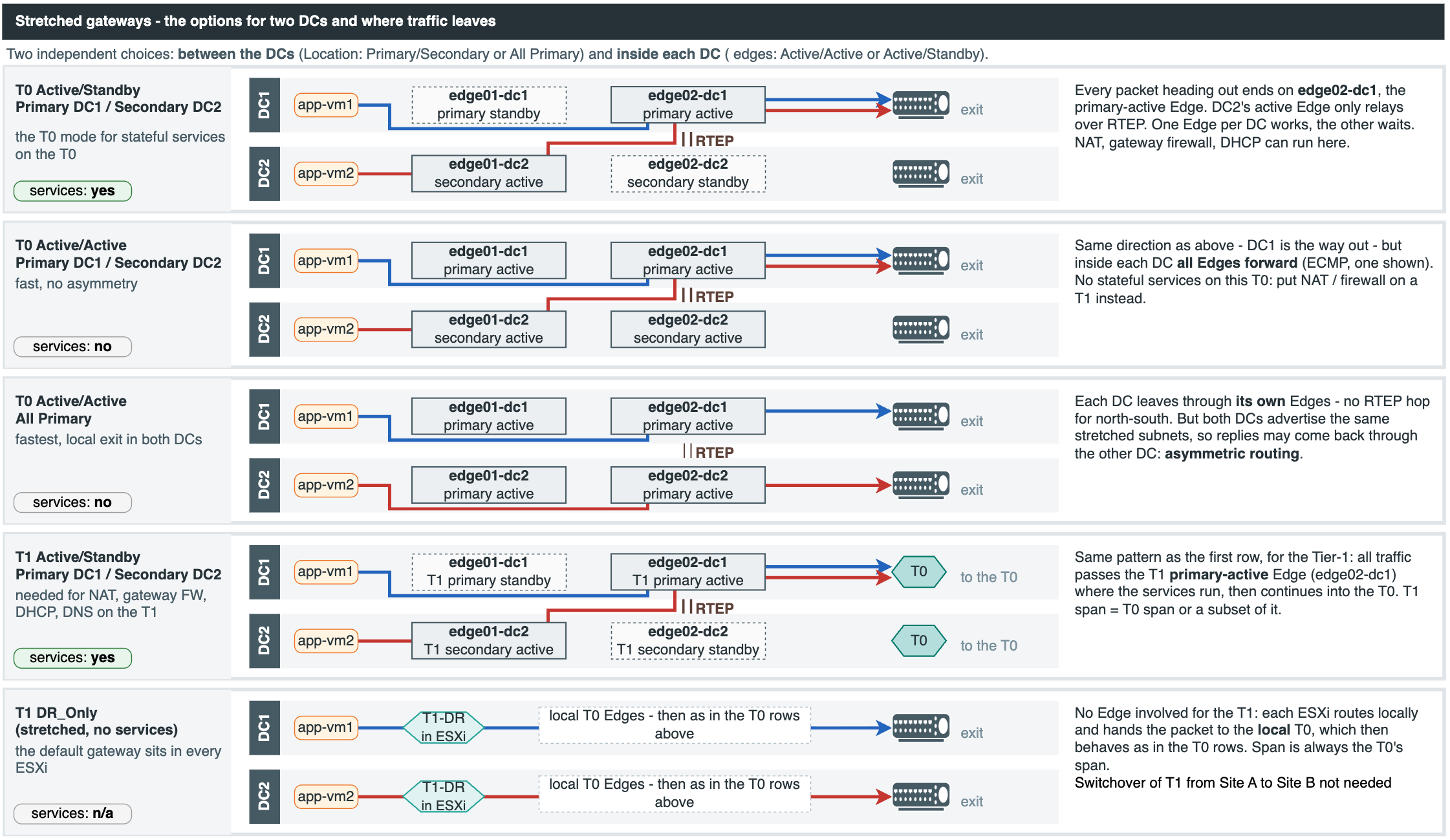
Which one should I pick? (guide’s best-practice summary)
• T0 A/S, Primary/Secondary – most services on the T0 (gateway firewall, NAT, DHCP).
• T0 A/A, Primary/Secondary – best performance without asymmetric routing; put central services on Tier-1s.
• T0 A/A, All Primary – best performance, but asymmetric routing is possible.
• Active/Active with stateful services is not supported in Federation.
Other parts of this series:
🔗 Part 1 (Architecture): Part 1: NSX Federation in VCF 9.1 – the architecture in 60 seconds
🔗 Part 2 (Management Plane): Part 2: NSX Federation in VCF 9.1 – Managament Plane in 60 seconds
🔗 Part 3 (Stretched segment): Part 3: NSX Federation in VCF 9.1 – one subnet-two DCs in 60 seconds


