TL;DR
A VCF fleet needs shared operational visibility and consistent controls without erasing each instance’s local responsibility. Decide which identity, lifecycle, observability, and automation services belong at fleet level, then preserve instance-level failure boundaries, capacity decisions, change windows, and recovery procedures. The networked-squadron illustration represents that balance between coordination and local control.
The practical design principle is coordinated autonomy. Centralize the controls that benefit from consistency, but keep execution and recovery close to the instance and workload domain where the impact occurs.
On this page
Introduction
Fleet coordination should improve consistency while leaving each VCF instance with an operable local failure and recovery model. The networked-squadron image helps explain this arrangement: shared information supports coordination, while each member retains defined responsibilities.
That is a useful mental model for VMware Cloud Foundation fleet management.
Many organizations understand the value of central management, but they often carry one of two flawed assumptions into the design. The first is that every VCF instance should be managed as a completely separate island. The second is that fleet management turns multiple instances into one giant control plane with one failure domain and one operating schedule.
Neither model is operationally healthy.
VCF fleet management is better understood as a coordination layer. It gives platform teams a consistent way to govern and observe multiple VCF instances, while each instance retains the local management structures required to operate its own infrastructure and workload domains.
Reading the Image as a VCF Fleet
The aircraft in the image are similar, connected, and moving toward a common objective. They are not identical in position, workload, or local conditions. That distinction matters.
In the VCF mental model, each aircraft represents a VCF instance. The internal compute racks, storage systems, network fabric, and control electronics represent the management domain and the workload domains that make the instance operational. The blue connections represent shared fleet-level management, policy, telemetry, identity, and lifecycle coordination. The protected city zones below represent the sites, regions, application estates, or business services supported by each instance.
The strongest lesson in the image is not central command. It is coordinated autonomy.
| Image element | VCF interpretation | Operational guardrail |
|---|---|---|
| Aircraft | A discrete VCF instance | Do not treat an instance as only another vCenter endpoint |
| Internal systems | Management domain, workload domains, clusters, and platform components | Keep local control dependencies and recovery procedures explicit |
| Blue network links | Fleet-level management, identity, policy, telemetry, and automation | Do not confuse management connectivity with workload data-plane traffic |
| Formation | Shared standards and coordinated execution | Consistency should not erase site or workload differences |
| Protected city zones | Sites, regions, business services, and application estates | Design around real failure domains and service requirements |
| Lead aircraft | Shared fleet-level services and operational coordination | Protect the management layer and avoid a single-person or single-appliance operating model |
The metaphor becomes dangerous when the blue links are interpreted as a requirement for every workload to communicate through a central point. Fleet coordination is not a reason to centralize application traffic, flatten network boundaries, or merge independent failure domains.
Fleet Architecture at a Glance
The following diagram separates the shared fleet services from the management and workload boundaries inside each VCF instance. The key point is that fleet-level visibility and governance sit above the instances, while local execution remains inside them.
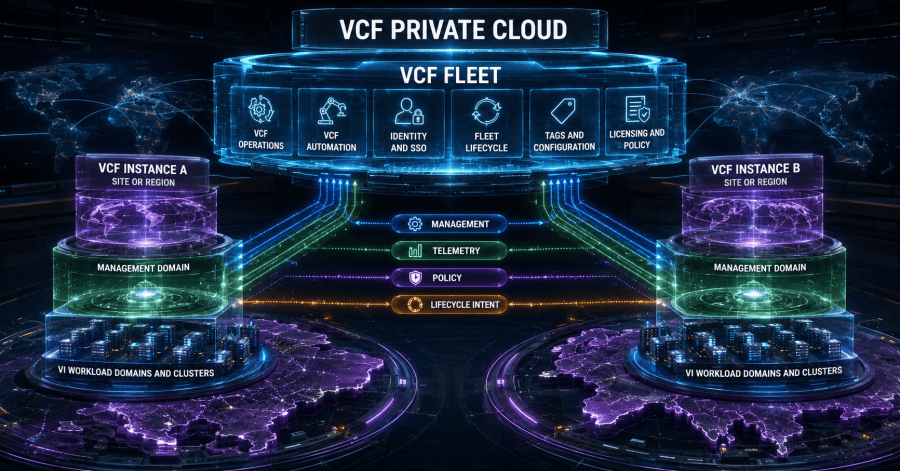
This is not a complete deployment blueprint. It is an ownership and control model. Network topology, appliance placement, identity design, high availability, disconnected operations, and recovery still require supported product design and environment-specific engineering.
Scenario: Four Instances, One Operating Model
Consider an enterprise with four major infrastructure locations:
- A primary production data center
- A secondary recovery site
- A regional manufacturing location
- A dedicated AI and analytics environment
The enterprise wants one private cloud program and a common operating model. It also needs different change windows, capacity profiles, security policies, and recovery procedures at each location.
Treating all four locations as completely separate environments would duplicate identity configuration, certificate practices, licensing workflows, taxonomy, reporting, automation, and lifecycle governance. The platform team would spend its time reconciling differences rather than improving the service.
Treating all four as one undifferentiated infrastructure domain would create a different problem. A single operational mistake could affect too much of the estate. Regional maintenance would become dependent on global scheduling. Local teams would lose the context needed to handle site-specific failures. Recovery procedures would be written for the imagined global platform rather than the actual failure domain.
A better posture is one fleet with multiple instances, provided the organization can accept the shared governance and identity boundary. The fleet establishes common services and standards. Each instance remains aligned to a location, operational boundary, or infrastructure purpose.
Scope and Terminology Guardrails
The VCF hierarchy needs to remain clear because fleet, instance, domain, cluster, and private cloud are not interchangeable terms.
VCF private cloud
The private cloud is the highest-level program and consumption model. It may contain one or more fleets when organizational, regulatory, identity, or operational separation requires it.
VCF fleet
A fleet contains one or more VCF instances that use shared fleet-level management components and governance services. The fleet is the natural scope for common operations, automation, identity, licensing, lifecycle coordination, and fleet-wide standards.
VCF instance
A VCF instance is a discrete software-defined data center footprint with its own management domain and optional workload domains. It is the level at which local infrastructure dependencies, instance lifecycle, and many failure scenarios become real.
VCF domain
A management domain or VI workload domain is an important lifecycle, isolation, and blast-radius boundary inside an instance. Domains should be designed around workload classes, change windows, infrastructure requirements, and operational ownership rather than created only because capacity exists.
Cluster
A cluster is a capacity, availability, and scaling unit. It is not the fleet, instance, or governance boundary by itself.
The most useful meeting-room language is simple:
Private cloud = the enterprise service
Fleet         = shared governance and fleet services
Instance      = discrete SDDC footprint
Domain        = lifecycle and isolation boundary
Cluster       = capacity and availability unit
Assumptions Behind the Mental Model
This article assumes the following operating posture:
- The organization is designing or operating VMware Cloud Foundation 9.x.
- The target model uses one private cloud and one fleet with multiple VCF instances.
- VCF Operations and VCF Automation are treated as shared fleet-level services.
- Each instance retains its own management domain and local infrastructure control planes.
- Sites have reliable routed connectivity for supported management workflows.
- Identity, DNS, NTP, certificates, software depot access, backup, and recovery are engineered as platform dependencies.
- Local teams require enough authority and runbook coverage to respond when fleet-level services or wide-area connectivity are degraded.
- The final design will be validated against current Broadcom documentation, interoperability guidance, sizing, and support requirements.
The model changes when regulatory isolation, separate enterprises, incompatible identity boundaries, disconnected operations, or independent lifecycle governance make a shared fleet inappropriate.
What Belongs at Fleet Level
The best candidates for fleet-level control are capabilities where inconsistency creates risk, wasted effort, or weak governance.
Identity and access patterns
Shared identity and single sign-on can reduce repeated configuration and simplify operator access. The benefit is not only convenience. A common identity model can improve role consistency, offboarding, auditability, and entitlement review.
The tradeoff is blast radius. A bad federation change, expired trust, or incorrect role mapping can affect many components at once. Fleet-level identity therefore requires high-availability design, tested break-glass procedures, and clear separation between identity administration and infrastructure administration.
Password and certificate governance
Password expiration and certificate lifecycle problems are predictable, but they remain common causes of failed upgrades, broken integrations, and emergency maintenance. Central visibility helps the platform team identify risk before it becomes an outage.
Centralized visibility does not remove local responsibility. Instance owners still need to understand which services consume each certificate, what restart behavior is required, how renewal is validated, and how to recover when automation fails halfway through a workflow.
Lifecycle planning
Fleet-level lifecycle coordination provides the shared view needed to understand software availability, component sequencing, health prerequisites, security exposure, and maintenance progress. In VCF 9.1, Broadcom positions VCF Operations as a more unified lifecycle interface for planning and executing updates across fleet components and workload domains.
The operational interpretation is important. A central plan should create consistent gates, not force every instance into the same maintenance window. Instance owners still need to validate capacity, workload mobility, backup state, application constraints, and local business timing.
Tagging, configuration, and metadata
Fleet-wide tag and configuration practices are foundational for automation, cost allocation, operational reporting, security policy, backup selection, and ownership mapping. VCF 9.1 expands centralized tag visibility and synchronization while preserving options for local control where needed.
A tag is not governance by itself. Organizations still need controlled categories, owners, naming standards, exception handling, and a process for deciding which tags are authoritative. Otherwise, the fleet simply distributes inconsistent metadata faster.
Licensing and capacity visibility
Centralized licensing and capacity views reduce the effort required to understand consumption across multiple environments. They also give platform owners a better basis for capacity planning, showback, chargeback, and investment decisions.
The fleet view should not replace instance-level engineering. Capacity risk usually becomes actionable at the cluster, domain, and site level, where hardware constraints, failure tolerance, workload demand, and procurement lead times differ.
Observability and diagnostic context
VCF Operations provides the shared operational picture that the squadron metaphor depends on. Health, diagnostics, metrics, logs, capacity, security findings, and network context can be correlated across the estate rather than reviewed as isolated product consoles.
Broadcom’s VCF 9.1 materials describe faster metric collection, integrated log management, health and diagnostic findings, security advisory visibility, and APIs that can feed ticketing, risk, analytics, or AI-assisted operational workflows. These capabilities can shorten investigation time, but only when ownership, alert routing, service priorities, and escalation paths are defined.
What Must Remain Local
Central management is valuable only when it respects the boundaries that keep the platform resilient and operable.
Instance management domains
Each VCF instance has local management dependencies that must be protected, backed up, monitored, and recovered. The fleet should know the state of the instance, but it does not eliminate the instance’s management domain or make local component health irrelevant.
The first design question during an incident should be scope:
Is this a fleet service issue?
Is this an instance management issue?
Is this a workload domain issue?
Is this a cluster or workload issue?
That sequence prevents a local failure from being treated as a global outage, and it prevents a fleet-level identity or lifecycle problem from being misdiagnosed as a single vCenter issue.
Failure domains
Sites, regions, network paths, power boundaries, storage systems, and management clusters fail in different ways. The fleet view should make those differences visible rather than hide them behind one dashboard.
If two instances depend on the same identity service, software depot path, DNS service, certificate authority, backup target, or wide-area circuit, they may share more failure risk than the topology diagram suggests. Those dependencies belong in the architecture, risk register, and recovery tests.
Change windows
A fleet can share lifecycle policy without sharing one maintenance schedule. Production, recovery, manufacturing, and AI environments may have different workload mobility, hardware dependencies, uptime requirements, and application validation processes.
The fleet owner should define the minimum readiness gates. Instance owners should decide when their environment is ready to pass through those gates.
Local capacity and workload behavior
The fleet may identify a capacity trend, but the response depends on local workload behavior. An AI cluster constrained by GPU placement, a database domain constrained by latency, and a general-purpose virtualization cluster constrained by memory are not interchangeable.
Fleet-wide standards should create comparable telemetry and decision criteria. They should not flatten different workload economics into one generic threshold.
The Coordinated Autonomy Model
A strong operating model separates intent, execution, and evidence.
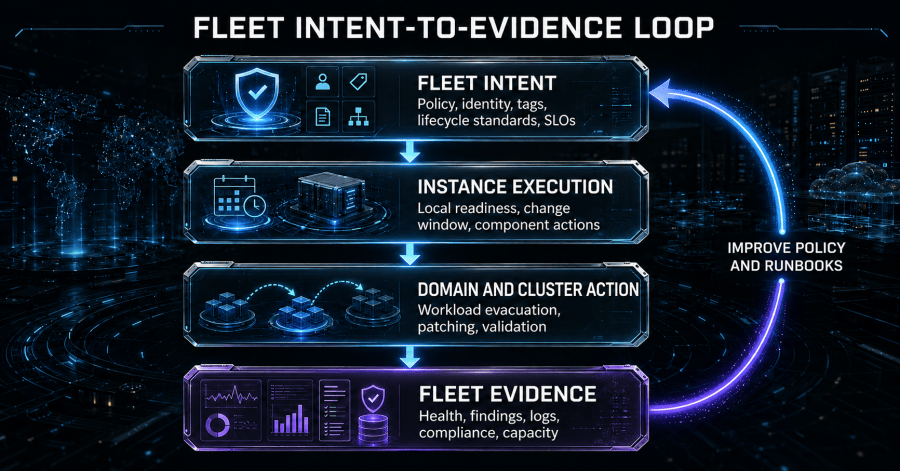
This loop is more useful than a simple top-down control model.
The fleet establishes what good looks like. The instance determines how the standard is applied to its environment. Domains and clusters execute the technical work. Evidence returns to the fleet so the organization can identify drift, recurring failure patterns, weak readiness checks, and automation opportunities.
Decision Criteria for One Fleet or Multiple Fleets
The image shows one connected formation, but not every enterprise should use one fleet.
| Decision criterion | One fleet is usually stronger when | Multiple fleets are usually stronger when |
|---|---|---|
| Identity | A common enterprise identity and access model is acceptable | Separate identity authorities or hard authentication boundaries are required |
| Governance | Shared lifecycle, tagging, licensing, and operational policy are desired | Business units or regulated environments require independent governance |
| Change management | Teams can use shared standards with instance-specific schedules | Fleet services themselves require separate change windows |
| Connectivity | Management connectivity is reliable and supportable | Sites are frequently disconnected or operationally autonomous |
| Failure tolerance | Shared fleet-level dependencies are acceptable and protected | Shared dependencies create unacceptable enterprise-wide risk |
| Organization | One platform team can own the shared service | Separate legal entities or operating companies need independent accountability |
| Automation | Common APIs, pipelines, and service catalogs create leverage | Automation must be isolated for security, tenancy, or contractual reasons |
| Recovery | Fleet services can be protected to the required service level | Each environment requires independently recoverable management services |
The fleet count should be an architectural decision, not a default selected because the installer makes one path easy. It affects identity, governance, service availability, operational staffing, automation, and recovery.
Ownership and Operational Handoffs
The networked squadron model fails when everyone can see the fleet but nobody owns the decisions.
Fleet owner
The fleet owner is accountable for shared services and global standards. Typical responsibilities include:
- Fleet topology and service availability
- Identity integration and role design
- Certificate and password policy
- Lifecycle standards and readiness gates
- Tagging and configuration governance
- Licensing and fleet capacity reporting
- Observability standards and platform SLOs
- Automation interfaces, pipelines, and guardrails
- Fleet-level backup and recovery planning
Instance owner
The instance owner is accountable for the health and execution of a discrete VCF footprint. Typical responsibilities include:
- Management domain availability
- Instance component health and backup
- Local network, DNS, NTP, and certificate dependencies
- Workload domain lifecycle coordination
- Capacity and hardware planning
- Maintenance scheduling
- Site-specific incident response
- Validation after upgrades and configuration changes
Domain and workload owner
Domain and workload owners provide the application and service context that infrastructure teams cannot infer from a dashboard. Their responsibilities include workload criticality, maintenance tolerance, application validation, data protection, performance requirements, and service acceptance.
Security and identity owners
Security and identity teams own controls that cross the platform, but they must participate in change planning and incident response. Federation, privileged access, certificate authority changes, vulnerability response, and compliance evidence are shared operational concerns, not external approvals that appear only at the end of a project.
A Practical Day-2 Runbook
A fleet operating model becomes real when it produces repeatable routines.
Daily
- Review fleet health, active findings, failed workflows, and critical capacity alerts.
- Confirm that identity, telemetry, logging, and management connectivity are healthy.
- Triage incidents by fleet, instance, domain, cluster, and workload scope.
- Route alerts to named owners rather than a shared queue with no accountability.
Weekly
- Review pending security advisories, lifecycle prerequisites, and diagnostic findings.
- Validate backups for fleet-level services and instance management components.
- Review failed certificate, password, automation, and configuration workflows.
- Confirm that critical tags and ownership metadata remain complete.
- Review disconnected or stale data sources before treating the fleet dashboard as authoritative.
Monthly
- Review certificate expiration, account expiration, entitlement growth, and break-glass access.
- Compare configuration baselines and investigate out-of-band changes.
- Review capacity forecasts by instance, domain, and cluster.
- Test one recovery or degraded-mode procedure instead of assuming the runbook still works.
- Review lifecycle wave plans, maintenance windows, application dependencies, and rollback criteria.
Quarterly
- Reassess whether the current fleet boundary still matches regulatory, identity, organizational, and recovery requirements.
- Review platform SLOs and incident trends.
- Remove unused integrations, stale tags, obsolete automation, and unsupported exceptions.
- Validate that staffing and escalation coverage match the expanded fleet scope.
Automation Is the Coordination Fabric
The blue links in the image should be interpreted as API-driven coordination, not manual console access.
VCF 9.1 expands API and SDK coverage across more of the platform, including VCF Operations, NSX, logging, network operations, and fleet and SDDC lifecycle capabilities. That creates a stronger basis for integrating lifecycle, diagnostics, ticketing, compliance evidence, configuration, and operational workflows.
The opportunity is not to automate every button. It is to automate the control loop:
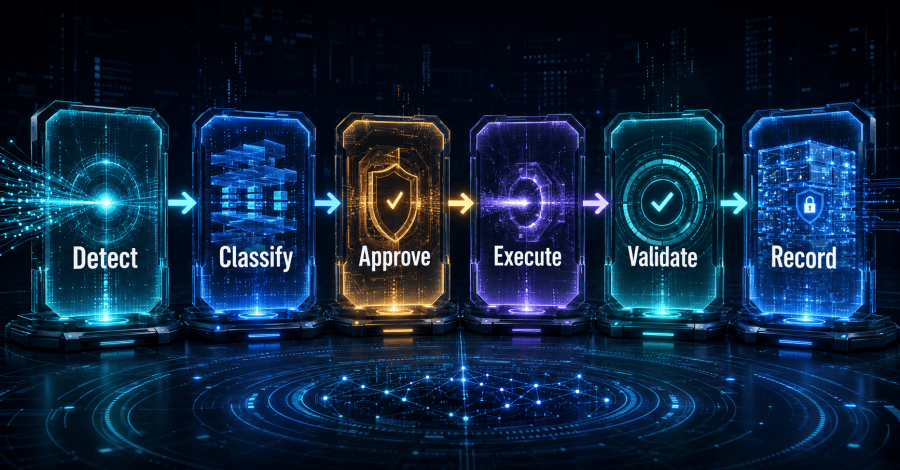
A production workflow should identify scope, enforce prerequisites, request the right approval, execute against the correct instance or domain, validate service health, and preserve evidence. Automation that skips scope classification or validation can make a fleet-wide mistake faster than a human operator.
Risks and Anti-Patterns
Treating the fleet as one giant instance
A fleet is not one oversized vCenter, one management domain, or one workload failure boundary. Designs that blur those layers create weak incident triage, oversized maintenance events, and confusing ownership.
Assuming a single pane of glass is a single source of truth
Central dashboards are valuable, but data can be delayed, disconnected, incomplete, or interpreted without local context. Operators need data freshness indicators, integration health, and a path to verify the source system.
Centralizing authority without local recovery
A fleet team that owns every decision but cannot reach a site during a network failure creates operational paralysis. Local break-glass access, documented degraded-mode procedures, and clear authority limits are essential.
Standardizing change windows instead of standards
The goal is a common process and evidence model, not one global maintenance window. Local workload and business constraints still determine execution timing.
Ignoring shared-service blast radius
Identity, DNS, NTP, certificate authorities, software depots, backup repositories, and fleet management services can become hidden common dependencies. High availability helps, but recovery testing and dependency mapping are still required.
Distributing metadata without governance
Fleet-wide tag synchronization can spread good standards or bad taxonomy. Define authoritative categories, ownership, allowed values, exceptions, and review processes before treating tags as automation inputs.
Automating without evidence
A successful API response does not prove the service is healthy. Automation must validate component state, workload availability, monitoring, logs, and application acceptance before closing the change.
Practical Design Recommendations
Start with boundaries before products. Decide what the enterprise wants to share and what it must isolate.
Define the fleet service level. Document availability targets, recovery objectives, backup scope, break-glass access, and degraded-mode expectations for fleet-level components.
Align instances to real operational boundaries. Sites, regions, infrastructure types, legal entities, and recovery models are stronger design inputs than arbitrary size alone.
Make lifecycle readiness measurable. Use common prechecks for health, capacity, backup, compatibility, workload mobility, and application validation, then allow instance-specific scheduling.
Create a controlled metadata model. Tags should support ownership, environment, service tier, backup, security, cost, and automation without becoming an unbounded collection of local labels.
Automate the evidence loop. Integrate diagnostics, lifecycle status, configuration, ticketing, and change records so the fleet learns from every maintenance event and incident.
Test loss of coordination. Validate what operators can still see and do when fleet services, identity, or wide-area connectivity are unavailable. The aircraft should remain stable even when the formation link is degraded.
Conclusion
The networked squadron is a useful VMware Cloud Foundation mental model because it shows the balance that private cloud teams need to achieve.
Each VCF instance must remain a real operational unit with its own management dependencies, workload domains, capacity decisions, change windows, and recovery procedures. At the same time, the enterprise gains leverage when identity, lifecycle standards, certificates, passwords, tags, licensing, observability, diagnostics, and automation are coordinated across the fleet.
The target is not maximum centralization. It is coordinated autonomy.
A well-designed fleet gives operators a shared picture, consistent controls, and repeatable workflows without pretending that every site, domain, cluster, and workload has the same risk or the same operating conditions. That is how VCF fleet management scales from a collection of infrastructure environments into a private cloud operating model.