TL;DR
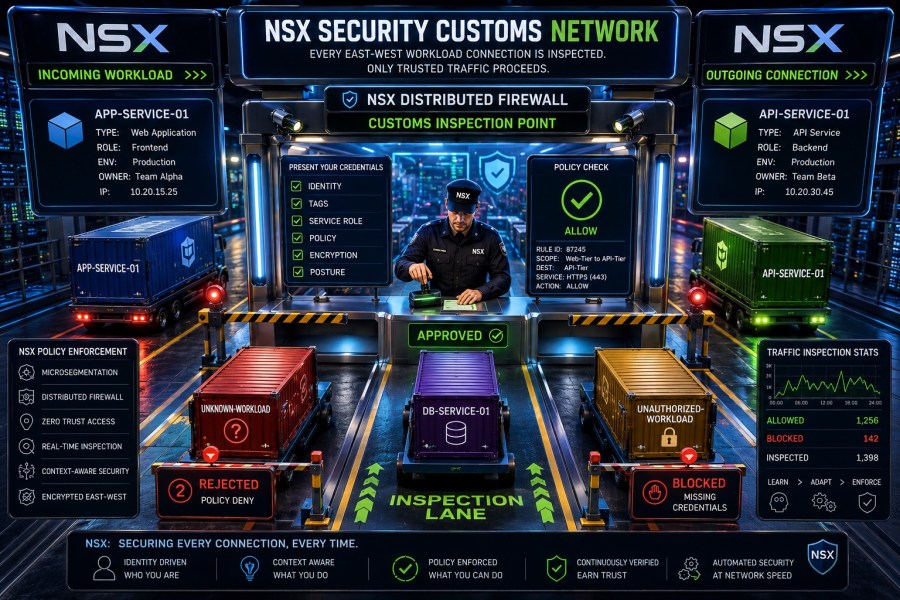
The customs network shown in the image is a useful way to explain NSX Distributed Firewall microsegmentation. A workload should not communicate with another workload simply because both systems reside inside the same data center. Its identity, application role, environment, destination, requested service, and effective security policy should determine whether the connection is allowed.
The metaphor becomes more accurate when one important correction is made: NSX does not send every east-west connection through one centralized inspection booth. Distributed Firewall policy is enforced close to the workloads, allowing security controls to follow application communication without forcing traffic through a separate physical firewall.
Introduction
Traditional data center security often assumes that the difficult part is keeping attackers outside the perimeter. Once traffic crosses the perimeter firewall, internal systems are frequently given far more trust than they should receive.
That assumption no longer matches how enterprise applications operate. Modern workloads communicate across web, API, database, identity, messaging, management, monitoring, and shared service tiers. One compromised server can become a launch point for lateral movement if those internal paths remain broadly open.
The image reframes this problem as a security customs network. Every workload arrives with declared attributes. The policy engine evaluates where it came from, what it represents, what service it is requesting, and whether an approved communication path exists. Known and authorized traffic proceeds. Unknown, incorrectly classified, or unauthorized traffic is rejected.
Many practitioners still refer to this capability as NSX Distributed Firewall or NSX DFW. Within the current VMware Cloud Foundation security documentation baseline, the capability is presented through VMware vDefend Distributed Firewall. The operational objective remains familiar: enforce granular east-west policy as close to the protected workloads as possible.
The Security Customs Network Mental Model
A physical customs checkpoint does not approve a shipment because a truck successfully reached the border. Inspectors evaluate the shipment against a set of conditions.
A workload connection should be treated the same way. Reaching the virtual network should not grant permission to consume an application service.
An effective policy decision should answer several questions:
- What workload initiated the connection?
- What application and tier does it belong to?
- Which environment owns it?
- What destination is it attempting to reach?
- Which protocol or service is being requested?
- Does an explicit policy authorize that relationship?
- Is the workload classification still accurate?
- Should the connection be allowed, denied, logged, or investigated?
This approach replaces location-based trust with policy-based authorization. The source IP address can still be relevant, but it should not be the only information determining access.
What the Image Gets Right
The image captures several important characteristics of a mature NSX microsegmentation design.
Workload Identity Matters
The incoming workload is identified as an application service with a role, environment, owner, and address. That is much more useful than treating it as an anonymous IP address.
A production web server owned by one application team should not receive the same access as a development utility server, even when both systems temporarily share the same subnet.
Tags and Groups Provide Context
NSX tags and groups allow policy to follow workload attributes instead of depending entirely on static network placement. A virtual machine can be grouped according to application, tier, environment, sensitivity, tenant, or operational state.
That enables policy such as:
- Production web workloads may reach the production API group over HTTPS.
- Production API workloads may reach the approved database group over the required database service.
- Development workloads may not initiate connections to production application tiers.
- Quarantined workloads may communicate only with approved remediation services.
The result is security policy that expresses application intent rather than reproducing a spreadsheet of IP addresses.
Application Roles Define Allowed Paths
The image shows a frontend workload attempting to reach an API service. The important relationship is not simply one address connecting to another address. It is a web tier consuming an approved backend service.
That relationship can remain meaningful even when virtual machines are replaced, moved, scaled, or assigned new addresses, provided the workload classification and group membership remain accurate.
Policy Produces an Explicit Decision
The customs officer in the image produces a visible allow or deny outcome. NSX policy should be similarly deterministic.
Operators should be able to identify:
- Which rule matched
- Which source and destination groups were involved
- Which service was evaluated
- Which scope received the rule
- Which action was applied
- Which telemetry was generated
A security control that cannot explain why traffic was permitted is difficult to audit and even harder to troubleshoot.
How the Policy Decision Works
The following diagram translates the customs metaphor into a simplified policy evaluation path.
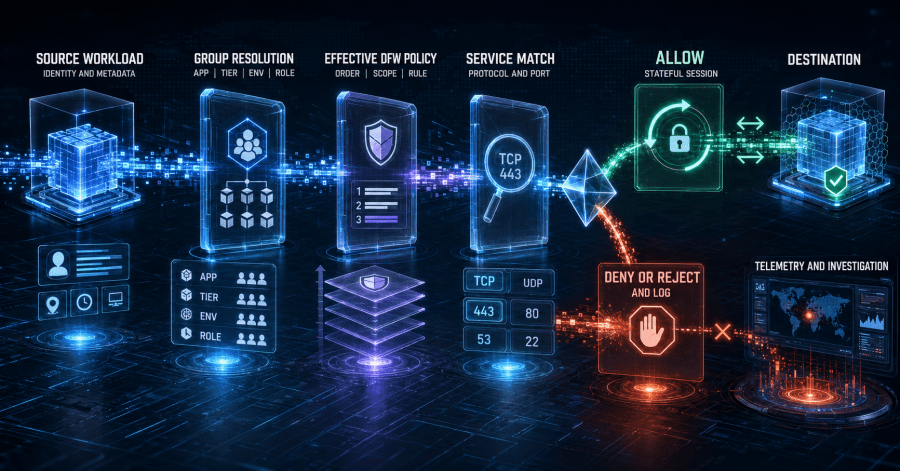
The point to notice is that several dependencies exist before the final decision. Group membership must be correct. Rule order must be understood. Service definitions must match the application. Scope must cover the intended workloads. Logging must provide enough evidence to explain the result.
A technically valid firewall rule can still produce the wrong outcome when any of those supporting elements are inaccurate.
The image is valuable, but it deliberately simplifies several aspects of the architecture.
Enforcement Is Distributed, Not Centralized
The visual places one customs booth in the center of every connection. A literal implementation of that design would require east-west traffic to pass through a centralized inspection appliance.
That is not the core Distributed Firewall model. Policy is centrally defined and distributed to enforcement points associated with the protected compute environment. Traffic can therefore be evaluated close to its source or destination workload without unnecessary hairpin routing.
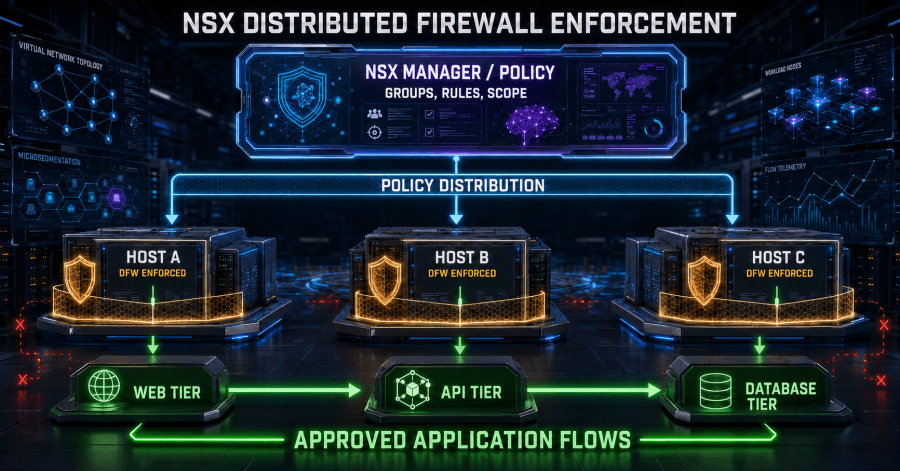
The NSX Manager and policy services provide centralized control. The workload path receives distributed enforcement.
That distinction matters for architecture reviews. The management plane may be centralized, but the traffic enforcement model is not equivalent to placing one large firewall in the middle of the data center.
Identity Is Not Available for Every Connection
The image treats identity as a universal credential carried by every workload. In practice, identity-aware policy applies to specific architectures and use cases. Service-to-service communication is often identified through workload groups, tags, addresses, application roles, and service definitions rather than a human user identity.
Identity Firewall can add user or directory context where the design supports it, but it should not be presented as an automatic attribute attached to every east-west flow.
Encryption Is Not a Universal Admission Field
The image lists encryption as one of the credentials inspected before approval. This is a useful security objective, but Distributed Firewall policy should not be confused with a universal certificate, TLS configuration, or cryptographic posture engine.
A rule can restrict communication to an approved encrypted service, such as HTTPS, but verifying certificate quality, protocol configuration, key management, and application-level encryption normally requires complementary controls.
Workload Posture Requires Reliable Data
The image also includes posture as an inspection attribute. Posture can include vulnerability state, endpoint health, quarantine status, compliance state, or operational classification.
NSX policy can consume useful grouping and classification data, but the quality of the decision depends on the systems producing that data. A stale tag or failed automation pipeline can cause a healthy workload to be blocked or a risky workload to retain access.
Zero trust policy is only as accurate as the context feeding it.
Designing Policy Around Application Intent
A strong NSX policy model begins with application dependencies, not firewall syntax.
Establish a Workload Classification Standard
Before creating rules, define the attributes the organization will use consistently. A practical taxonomy might include:
| Policy Attribute | Example Values | Operational Purpose |
|---|---|---|
| Application | Billing, Customer Portal, Monitoring | Identifies the owning service |
| Tier | Web, API, Database, Messaging | Defines application function |
| Environment | Production, Test, Development | Separates lifecycle boundaries |
| Owner | Platform Team, Team Alpha, Team Beta | Establishes accountability |
| Sensitivity | Public, Internal, Restricted | Supports security handling |
| State | Active, Maintenance, Quarantine | Supports temporary controls |
The exact vocabulary is less important than consistency. Teams should avoid creating multiple tags that mean almost the same thing, such as prod, production, prd, and live.
Build Groups from Stable Attributes
Dynamic groups should be based on attributes that are dependable and operationally owned. An application group can combine application name, tier, and environment to reduce accidental membership.
For example:
GRP-PROD-PORTAL-WEB
GRP-PROD-PORTAL-API
GRP-PROD-PORTAL-DB
GRP-PROD-SHARED-DNS
GRP-PROD-QUARANTINE
Group names should help an operator understand purpose without opening every membership expression. They should also follow a naming standard that automation can validate.
Define Communication as a Service Contract
Every allowed relationship should answer three questions:
- Which source role requires access?
- Which destination role provides the service?
- Which service is required for that dependency?
A rule should not permit all communication between two broad application groups when the actual requirement is one HTTPS service.
Scope Policy Deliberately
The Applied To scope is not a cosmetic setting. It controls where policy is realized and can affect performance, troubleshooting, and administrative understanding.
An unnecessarily broad scope increases the number of workloads receiving policy and makes effective-rule analysis more difficult. An overly narrow scope can leave workloads outside the intended enforcement boundary.
Treat Default Deny as an Outcome, Not a Starting Slogan
A deny-by-default posture is an important objective, but applying it before application flows are understood can create an outage rather than a security improvement.
A responsible rollout discovers dependencies, validates ownership, models required communication, observes policy behavior, and then introduces enforcement in controlled waves.
A Practical Application Policy Example
Consider the application shown in the image:
APP-SERVICE-01provides the web frontend.API-SERVICE-01provides backend application functions.DB-SERVICE-01stores application data.- Unknown workloads have no trusted application classification.
A simplified service policy could look like this:
| Source Group | Destination Group | Service | Action | Reason |
|---|---|---|---|---|
| Production Web | Production API | HTTPS | Allow | Approved frontend-to-backend dependency |
| Production API | Production Database | Approved database service | Allow | Required application data access |
| Production Web | Production Database | Any | Deny | Web tier must not bypass the API tier |
| Unknown Workloads | Production Application Tiers | Any | Deny and log | Unclassified workloads receive no implicit trust |
| Quarantine Group | Remediation Services | Approved remediation services | Allow | Supports investigation and recovery |
| Quarantine Group | Other Production Workloads | Any | Deny | Contains suspected compromise |
This is intentionally simple. Real applications often require DNS, time synchronization, identity, monitoring, backup, certificate, logging, and management services. Those shared dependencies should be documented separately rather than hidden inside broad application rules.
Moving from Learning to Enforcement
The image includes a progression of learn, adapt, and enforce. That sequence is operationally sound when it is treated as a controlled policy lifecycle.
Discover Real Application Flows
Start with evidence. Collect representative traffic across normal business periods, maintenance windows, batch cycles, backup jobs, failover testing, and month-end or quarter-end processing.
A short observation window can miss critical but infrequent dependencies.
Assign Dependency Ownership
Every proposed flow should have an application or platform owner who can explain why it exists. Security teams should not be forced to reverse-engineer application architecture from packets alone.
Undocumented communication is a design problem, not just a firewall problem.
Model Groups and Services
Translate confirmed dependencies into reusable groups and service definitions. Avoid creating one-off objects for every temporary change unless the exception is explicitly time-bounded.
Introduce Policy in Small Waves
Begin with a limited application or low-risk segment. Validate expected traffic, unexpected traffic, logging quality, operational ownership, and rollback procedures before expanding.
Enforce and Review Continuously
Policy is not complete when the initial rules are deployed. Applications change, ownership changes, services move, and temporary exceptions accumulate.
The organization needs an operating cycle that detects drift and removes access that is no longer required.
Operational Metrics That Matter
A traffic inspection dashboard is useful only when the numbers lead to action. Counting allowed and blocked flows without context can produce a false sense of control.
Useful operational measures include:
- Denied flows by application and rule
- Unclassified workloads attempting production access
- Group membership changes
- Workloads missing required tags
- Rules with no recent hits
- Broad allow rules with growing usage
- Policy exceptions approaching expiration
- Unexpected new application dependencies
- Time required to approve legitimate access
- Time required to contain a compromised workload
Some of these measures may come directly from firewall logging. Others may require flow analytics, operational monitoring, automation, or a security analytics platform.
The important outcome is traceability from the observed connection back to the workload, group, policy, owner, and change record.
Governance Must Support the Technology
Distributed Firewall policy crosses several operational teams. Treating it as the exclusive responsibility of the network team usually creates bottlenecks and incomplete application context.
| Role | Primary Responsibility |
|---|---|
| Application Owner | Documents dependencies and approves intended communication |
| Security Engineering | Defines segmentation standards, guardrails, and exception policy |
| NSX Platform Team | Maintains DFW health, objects, integrations, and policy deployment |
| Automation Team | Maintains tagging, group membership, validation, and drift workflows |
| Security Operations | Investigates denied traffic, suspicious flows, and containment events |
| Change Management | Preserves approval, testing, rollback, and evidence requirements |
Ownership should be explicit before enforcement begins. Otherwise, every blocked flow turns into a meeting where each team assumes another team understands the application.
Common Failure Modes
Building Policy Around IP Addresses Alone
Address-based rules are sometimes unavoidable, especially for legacy systems. They become fragile when used as the primary application identity model.
Workload replacement, address changes, disaster recovery, and scaling events can break the relationship between the address and the business role it was intended to represent.
Allowing Tag Sprawl
Tags are powerful because they influence dynamic membership. That also makes uncontrolled tagging dangerous.
A misspelled environment tag may remove a workload from required policy. An overly broad application tag may grant access to systems that do not belong in the group.
Creating Broad Any-to-Any Exceptions
Temporary exceptions tend to become permanent when they have no owner, expiration date, or review process. Broad rules also hide application dependencies that should have been modeled explicitly.
Ignoring Rule Order and Scope
A well-written rule can be ineffective when an earlier rule already matches the traffic or when the intended workloads never receive the policy. Troubleshooting must examine the effective policy, not only the rule an operator expected to match.
Enforcing Before Observing
A default-deny policy deployed without dependency discovery can interrupt DNS, monitoring, authentication, backup, patching, or application health checks.
The most dangerous missing flows are often shared infrastructure services that application teams assumed were simply part of the network.
Treating DFW as the Entire Zero Trust Architecture
Microsegmentation is a major zero trust control, but it does not replace identity governance, vulnerability management, endpoint protection, secure application design, encryption, secrets management, observability, or incident response.
The firewall controls communication. It cannot make an unpatched or poorly designed application trustworthy.
Implementation Checklist
Before enforcing an NSX microsegmentation policy, confirm that:
- Application owners have validated their dependencies.
- Workload tags follow an approved taxonomy.
- Dynamic group membership is tested.
- Source, destination, service, action, and scope are explicit.
- Shared infrastructure dependencies are documented.
- Unknown and unclassified workloads have a defined handling policy.
- Logging is enabled where operationally useful.
- Operators can identify the effective matching rule.
- Exceptions include owners and expiration dates.
- Rollback procedures are documented and tested.
- Monitoring can detect group, tag, and policy drift.
- Incident responders can quarantine a workload without improvising policy during an emergency.
Conclusion
The security customs network is an effective mental model because it changes the central question. Instead of asking whether two systems can reach each other, it asks whether the connection should be permitted based on application intent, workload context, and an explicit policy decision.
NSX Distributed Firewall supports that model by bringing east-west policy enforcement close to protected workloads. Tags, groups, application roles, service definitions, scope, and logging combine to create a policy system that can remain meaningful as infrastructure changes.
The model succeeds only when the supporting operational disciplines are present. Tags must be governed. Application dependencies must be owned. Rules must be scoped and reviewed. Exceptions must expire. Telemetry must be actionable. Complementary controls must address the areas that a distributed firewall cannot validate by itself.
The goal is not to inspect traffic merely to produce an allow or deny counter. The goal is to ensure that every approved connection represents a documented, necessary, and accountable relationship between enterprise workloads.