
TL;DR
- Converting a VM to managed disks is usually operationally straightforward: deallocate, convert, start, validate.
- The real work is coordination:
- availability set batching
- maintenance windows
- IP address behavior
- validation and rollback plan
- Expect a possible post-migration background-copy window where reads can be slower.
- Do not skip cleanup: original VHD blobs and storage accounts can keep accruing cost after conversion.
Architecture Diagram
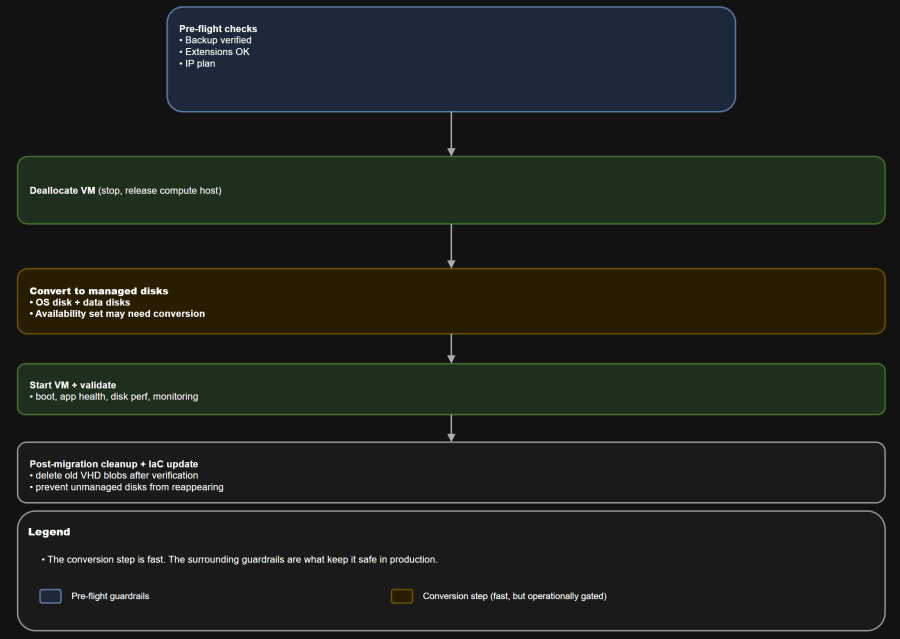
Table of Contents
- Scenario
- Core Concepts
- Prerequisites
- Version Compatibility Matrix
- Step-by-step
- Validation
- Troubleshooting Workflow
- Rollback Considerations
- Cost Model Snapshot
- Best Practices
- Conclusion
Scenario
You’ve identified one or more production VMs still using unmanaged disks. You need a runbook you can hand to an operations team that:
- minimizes human error
- scales across subscriptions and resource groups
- produces clear validation evidence for your change board
Core Concepts
- Unmanaged disks live as VHD page blobs inside a storage account.
- Managed disks are first-class Azure resources (disks) managed by the platform.
- The migration converts:
- OS disk
- attached data disks
- Constraints you must account for:
- VM must be deallocated during conversion
- availability set rules (no mixing disk types)
- some scenarios can change IP behavior if you rely on dynamic assignment
Prerequisites
Operational prerequisites:
- Confirm you have:
- VM owner approval
- approved maintenance window
- rollback plan
- Confirm backups:
- Azure Backup recovery point exists and is recent
- application-consistent backups where required
Technical prerequisites:
- VM is healthy:
- provisioning state is good
- extensions are healthy
- Networking plan:
- if the VM must keep its IP, ensure the right static configuration is in place before you begin
Version Compatibility Matrix
| Component | What you need | How you verify |
|---|---|---|
| Azure CLI | Azure CLI with az vm convert available |
az version and az vm convert --help |
| Azure PowerShell | Az.Compute with ConvertTo-AzVMManagedDisk |
Get-Command ConvertTo-AzVMManagedDisk |
| Permissions | At least Contributor on VM RG | Attempt a no-op read and confirm rights before change window |
Step-by-step
Step-by-step using Azure Portal
Use this when the count is low and you need a UI-backed change record.
- Open the VM
- Go to Disks
- Select Migrate to managed disks
- Review warnings:
- availability set conversion requirements
- downtime requirement
- Execute migration
- Start VM (if not auto-started) and validate
Step-by-step using Azure CLI
Use this for repeatability and batch execution.
For a single VM:
# Deallocate
az vm deallocate --resource-group <rg> --name <vm>

# Convert unmanaged -> managed
az vm convert --resource-group <rg> --name <vm>

# Start
az vm start --resource-group <rg> --name <vm>
For availability set VMs, plan to convert the availability set and migrate all VMs in the set in the same window:
# Convert availability set
az vm availability-set convert --resource-group <rg> --name <availabilitySetName
Step-by-step using Azure PowerShell
Use this for Windows-heavy ops teams and richer scripting.
Single VM conversion:
$rgName = "<rg>"
$vmName = "<vm>"

# Deallocate
Stop-AzVM -ResourceGroupName $rgName -Name $vmName -Force

# Convert (converts OS + data disks)
ConvertTo-AzVMManagedDisk -ResourceGroupName $rgName -VMName $vmName
Availability set conversion reminder:
- Convert the availability set to aligned SKU if required, then migrate all VMs in that set.
$rgName = "<rg>"
$avSetName = "<availabilitySet>"

$avSet = Get-AzAvailabilitySet -ResourceGroupName $rgName -Name $avSetName
Update-AzAvailabilitySet -AvailabilitySet $avSet -Sku Aligned
Validation
You want validation that proves:
- disks are now managed
- the VM boots and app is healthy
- monitoring and backups are still working
Resource Graph validation query
Resources
| where type =~ 'microsoft.compute/virtualmachines'
| extend osDisk = properties.storageProfile.osDisk
| extend usesManagedOsDisk = isnotnull(osDisk.managedDisk)
| project subscriptionId, resourceGroup, name, location, usesManagedOsDisk
PowerShell validation
$vm = Get-AzVM -ResourceGroupName "<rg>" -Name "<vm>"
$vm.StorageProfile.OsDisk.ManagedDisk -ne $null
Validation checklist:
- VM status: running
- application health: synthetic transaction or service check
- disk performance: baseline read latency compared to pre-change
- backup: next scheduled backup job succeeds
- logging: heartbeats and metrics flowing
Troubleshooting Workflow
Common failure modes you should expect:
- Extensions not in a succeeded state
- Fix extensions first, then retry migration.
- Availability set constraints
- Ensure the availability set itself is migrated correctly and all VMs are coordinated.
- Snapshot count exceeded
- Reduce snapshot counts and retry.
- IP changes
- If you relied on dynamic addressing, ensure the correct static IP approach was applied prior to conversion.
Operator workflow:
- stop
- identify blocking error
- remediate the blocking condition
- retry the conversion command
- validate again
Rollback Considerations
This migration is best treated as non-reversible in place.
Practical rollback patterns:
- Keep the original VHD blobs and storage account until you pass an agreed validation period.
- If rollback is required:
- recover using Azure Backup into a managed-disk VM workflow
- or build a new managed disk from the original VHD and create a replacement VM
Rollback decision gates:
- boot failure
- application health failure after restart
- unacceptable latency for the workload
Cost Model Snapshot
Hidden costs people forget:
- After conversion, the original VHD blobs and storage account are not deleted automatically.
- If you leave them, you keep paying storage costs and sometimes transaction costs.
FinOps checklist:
- tag conversion date
- set a cleanup date
- delete old artifacts only after validation and sign-off
Best Practices
- Convert one low-risk VM first to validate your runbook end to end.
- Batch by dependency domain:
- per app tier
- per availability set
- per maintenance window group
- Update IaC immediately after conversion:
- templates and modules should no longer reference storage account VHDs
- Document the new steady state:
- managed disks, backup behavior, operational runbooks
Conclusion
The conversion commands are easy. The success criteria are not. If you treat this like a production change with pre-flight, validation, and cleanup, you can migrate quickly without last-minute firefighting.
Sources
Migrate your Azure unmanaged disks by March 31, 2026: https://learn.microsoft.com/en-us/azure/virtual-machines/unmanaged-disks-deprecation
Convert a Windows VM from unmanaged disks to managed disks: https://learn.microsoft.com/en-us/azure/virtual-machines/windows/convert-unmanaged-to-managed-disks
Convert a Linux VM from unmanaged disks to managed disks: https://learn.microsoft.com/en-us/azure/virtual-machines/linux/convert-unmanaged-to-managed-disks
Frequently asked questions about disks: https://learn.microsoft.com/en-us/azure/virtual-machines/faq-for-disks
Migrate Azure VMs to Managed Disks in Azure: https://learn.microsoft.com/en-us/azure/virtual-machines/windows/migrate-to-managed-disks


